How it plays
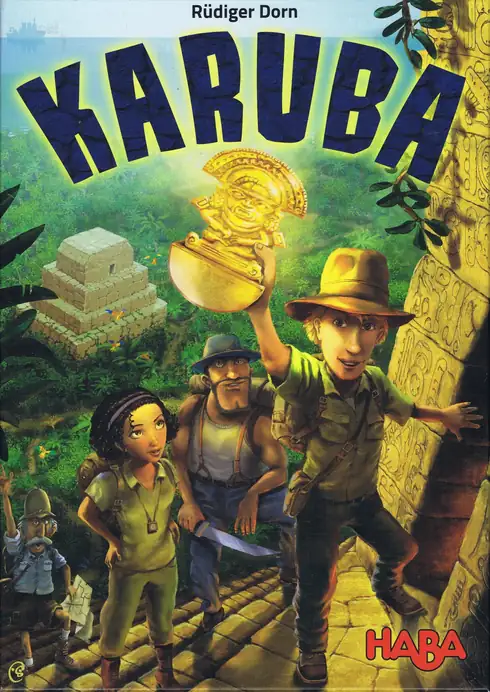
Everyone has their own jungle island and the same 36 numbered path tiles; adventurers and temples in four colors are placed the same way for everyone. A tile is revealed, and everyone takes the same one. They place it on their island without rotating it, or discard it to move an adventurer along paths already laid, by at most as many spaces as the tile has path exits. Crystals and gold go to whoever stops on them; at the temples, the earlier the arrival, the more valuable the reward. The game ends after the 36th tile or as soon as someone has all four adventurers in temples; whoever has the most points wins.
What it can help develop
Karuba is a planning puzzle with a race: the tiles come in random order and may not be rotated. Players have to think ahead about paths that do not yet exist, which calls for spatial reasoning and planning at the same time. Every tile raises the same question: keep building or move? Anyone who builds for too long reaches the temples too late. If the longed-for curve piece does not turn up, cognitive flexibility is needed to change plans.
Especially suitable for
- Children from age 8 who enjoy puzzling things out
- Mixed groups: nobody waits for their turn
- Families who would like to play without direct conflict
Less suitable for
- Groups looking for interaction and getting in each other’s way
- Children under 8: for them, there is a junior edition
Our verdict
Karuba is a worthwhile choice for families with children from age 8 who enjoy puzzling things out and prefer to play without direct conflict. Everyone builds their own jungle island at the same time, so nobody waits for their turn. In 2016, it was nominated for the Spiel des Jahres. Its limitations are the low level of interaction and the familiar basic principle; for children under 8, there is a junior edition.
Getting started
- Show the tile rule first: a tile is either placed on the island without rotating it or discarded to move an adventurer.
- Explain how far adventurers move: at most as many spaces as the tile has path exits, and only along paths already laid.
- Show the treasures and temples beforehand: crystals and gold are only collected by stopping on them, and at the temples, the earlier, the more valuable.
In detail
Variants and player count
According to Wikipedia, Karuba was designed by Rüdiger Dorn, was published by HABA and is intended for 2 to 4 people from age 8; BoardGameGeek gives 2015 as the year of publication. The components include four sets of 36 numbered jungle tiles each, adventurer figures and temples in four colors, as well as crystals (worth 1) and gold nuggets (worth 2). According to Wikipedia, a junior edition was also published in 2017.
What reviewers say
Karuba was nominated for the Spiel des Jahres in 2016; the jury praises the dual function of the tiles and the race element. According to Wikipedia, it took 6th place in the Deutscher Spiele Preis 2016. Ars Technica praises the accessibility and the absence of downtime; according to the English Wikipedia, Ars Technica criticizes the theme and the low level of interaction. Reich der Spiele says the mechanism is familiar from Take it Easy and Limes; what is new, according to Reich der Spiele, is discarding a tile in order to move.
How it compares
Azul (from age 8, 2 to 4 people, about 30 to 45 minutes) shares logic and planning with Karuba and, like Karuba, calls for planning ahead and spatial reasoning; Karuba has flexibility as a second skill area. Azul also calls for impulse control, and Azul is less suited to children who find penalty points hard to cope with. Nova Luna (from age 8, 1 to 4 people, about 30 minutes) shares both skill areas with Karuba, logic and planning as well as flexibility. Like Karuba, Nova Luna calls for planning ahead, spatial reasoning and cognitive flexibility, and it can also be played solo. Nova Luna is less suited to groups looking for laughter and conversation. Karuba suits children from age 8 who enjoy puzzling things out and mixed groups in which nobody waits for their turn; Karuba is less suited to groups looking for interaction and getting in each other’s way.
Sources
Frequently asked questions
What age is Karuba suitable for?
Karuba is recommended from age 8. A child is ready when they can think ahead about paths that have yet to be built and can decide whether to keep building or let an adventurer move. For younger children, there is a junior edition.
How long does a game take and how many people can play?
A game takes about 30 to 40 minutes. The game is for 2 to 4 people, who all play at the same time, each with their own island and the same tiles. The game ends after the 36th tile or when someone has all four adventurers in temples; whoever has the most points wins.
What skills can Karuba help develop?
The focus is on logic and planning as well as flexibility. Chance decides which tile comes next, and tiles may not be rotated. If the curve piece you want is missing, plans have to change, and anyone who builds for too long reaches the temples too late.
Do players get in each other’s way in Karuba?
Hardly. Everyone builds on their own island; it is a race to the temples without direct interference. Anyone looking for interaction and getting in each other’s way will find less of it here, but in return nobody waits for their turn.