How it plays
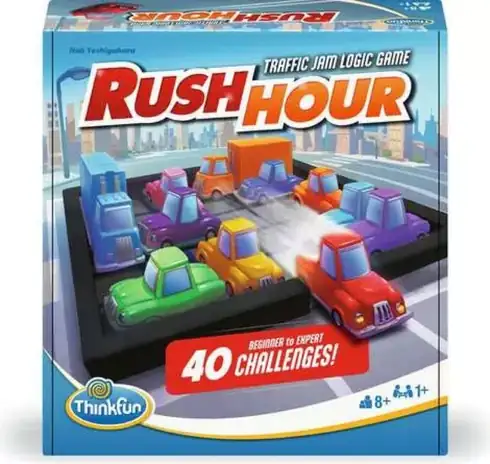
A puzzle game for one person: a traffic jam is set up on the 6×6 grid as shown on a challenge card. Cars take up two squares and trucks three; each vehicle only moves forwards or backwards and is never turned or lifted. The aim: to get the red car out through the only exit. The cards (40 in the edition reviewed) are graded in four levels from beginner to expert: at first, a few moves are enough, while later almost all the vehicles often have to be moved.
What it can help develop
Planning in its purest form: if, for example, a truck stands crosswise in front of the red car, it can only move out of the way once two cars have made room. So players think backwards from the goal and break the problem down into intermediate goals, whose order has to be kept in working memory. Quite often, even the red car has to reverse: the obvious move is then the wrong one. If a plan ends in a dead end, it is time to start again: cognitive flexibility. Later cards call for perseverance.
Especially suitable for
- Children from age 8 who enjoy puzzling things out on their own
- Adults who enjoy brain-teasers, too
- A quiet solo activity without a screen
Less suitable for
- Children who need company to play
- Anyone looking for a theme, a story or elements of luck
Our verdict
Rush Hour is a worthwhile choice for children from age eight and for adults who enjoy solving puzzles on their own. Its strength: the idea is simple, the challenges rise through four levels and many players want to solve the next card straight after the first. Its limitations are the purely solo format and the absence of theme and luck, as well as the plastic components, which have been criticized in some cases.
Getting started
- Show beforehand that vehicles only move forwards or backwards and are never turned or lifted.
- Expect the jump to the second level to be a big step for some; from then on, it helps to say the planned move out loud before sliding the vehicle.
In detail
Variants and player count
According to the German Ravensburger product page, the current ThinkFun edition 76599 includes a red car, 15 blocking vehicles and challenge cards with solutions. For that edition, Ravensburger gives the age as 8 to 99 years and the playing time as about 30 to 60 minutes. According to the German Wikipedia, no vehicle may jump over another, and the blocking vehicles may not leave the board. According to Reich der Spiele, anyone who has finished the basic cards needs new ones.
What reviewers say
Reich der Spiele calls the idea as simple as it is brilliant and describes how the game holds players for hours, so that they do not want to stop. Cliquenabend recommends Rush Hour to adults as well and says that it is addictive. According to Cliquenabend, the plastic components were annoying at first. On Hall9000, the verdict is that it is dangerously addictive. Comments there say that most levels can be solved fairly quickly and that the lid and sturdiness of the standard edition could be better. Rush Hour received the Mensa Select award in 1997, in the same year as Quoridor, among others.
How it compares
Rush Hour Jr. (from age 5, 1 person, flexible playing time) works as a stepping stone to the full Rush Hour and calls for planning ahead, spatial reasoning and frustration tolerance. Rush Hour Jr. is good for playing on the go, but experienced puzzlers from age 8 are better off going straight to the original. Jump In’ (from age 7, 1 person, flexible playing time) shares planning ahead and cognitive flexibility with Rush Hour. Thanks to the board with a lid, Jump In’ travels well, and the hard levels challenge older children and adults too. Impatient beginners, however, need time to get used to the jumping rules. All three are solo games and are less suited to children who prefer playing in company.
Sources
Frequently asked questions
What age is Rush Hour suitable for?
Rush Hour is recommended from age 8. A child who enjoys puzzling things out on their own and starts again after hitting a dead end is ready. Anyone who mainly looks for company when playing is less well served by it.
How long does a game take and how many people can play?
The playing time is flexible: at first, a few moves are enough; later, almost all the vehicles often have to be moved. Rush Hour is a puzzle game for 1 person, but often someone else watches over their shoulder and joins in the thinking.
What skills can Rush Hour help develop?
Rush Hour can help develop logic and planning. Players think backwards from the exit: if a truck blocks the way, other vehicles have to make room first. Sometimes the solution even involves moving the red car backwards.
What if a child gets stuck on a card?
The solution is on the back of the card. Testers looked at it for only 2 cards; if a child gets stuck, it is enough to show the next step of the solution and let them carry on thinking.