How it plays
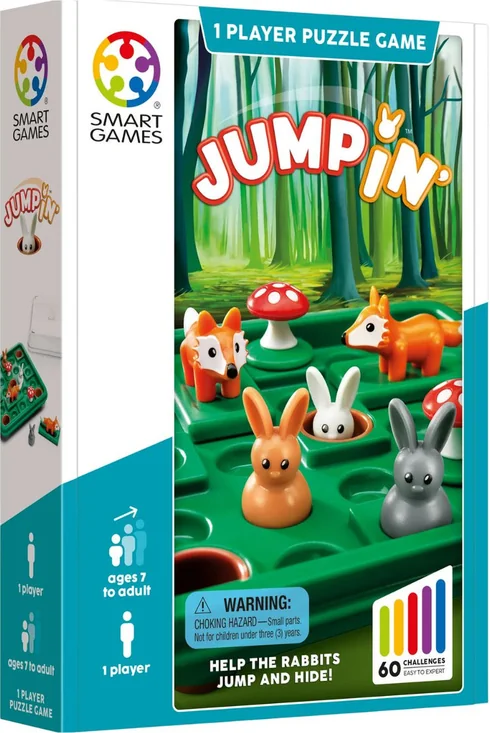
Each challenge in the booklet (60 in the edition reviewed) shows where up to three rabbits, two foxes and three mushrooms start on the board of 5 × 5 squares. Five brown holes in the corners and the middle serve as hiding places. Rabbits can only jump: horizontally or vertically over at least one occupied square to the first free one, never over empty squares. Foxes can only be slid back and forth, and mushrooms stay where they are. A challenge is solved as soon as all the rabbits are sitting in holes.
What it can help develop
A puzzle about sequences of moves: the goal is clear, and the route is a chain of moves that has to be thought out in advance (the hardest challenge needs at least 87). Each rabbit both jumps and stands in the way: sometimes a rabbit serves as a springboard, sometimes a rabbit has to come back out of its hole. Holding back the obvious move and rethinking calls for impulse control and cognitive flexibility. Moving foxes means creating obstacles or clearing landing squares: this is thinking in rows and columns.
Especially suitable for
- Children from age 7 who enjoy puzzling things out on their own
- On the go, thanks to the board with a lid
- Older children and adults, thanks to the difficult levels
Less suitable for
- Children who prefer playing in company
- Impatient beginners: the jumping rules take some getting used to
Our verdict
Jump In’ is a worthwhile choice for children from age 7 who enjoy puzzling things out on their own and, thanks to its difficult levels, also for older children and adults. In 2017, it won the Toy of the Year Award in Belgium, and in 2018 it was nominated for the Guldbrikken in Denmark. The board with a lid is easy to take along. Its limitations are the jumping rules, which are confusing at first, and the fact that it is purely a solo game.
Getting started
- Practice the jumping rule on its own first: a rabbit jumps horizontally or vertically over at least one occupied square and lands on the first free one, never jumping over empty squares.
- Point out two rules that are often overlooked: an empty hole is not an obstacle, and a rabbit may jump back out of a hole.
- Start with the easy challenges and think ahead before every jump. Anyone who skips this quickly slips into mere trial and error.
In detail
Variants and player count
In German, the game is published as “So hüpft der Hase” and in French as “Lièvres & Renards”; it is intended for 1 person from age 7. The components are a portable board with a lid, three rabbits, three mushrooms, two foxes and a booklet of challenges and solutions. The green board has 5 × 5 squares, and the brown holes are in the four corners and the middle. According to My Puzzle Collection, the challenges are graded in five levels of difficulty. According to smartgamesandpuzzles.com, the minimum number of moves is shown above each challenge, and the hardest one requires at least 87 moves. According to the French publisher’s page, the first challenges are played without foxes.
What reviewers say
In Belgium, the game won the Toy of the Year Award in 2017 in the thinking and logic games category, and in Denmark it was among the nominees for the Guldbrikken in 2018. My Puzzle Collection calls the game deceptively difficult and the rules somewhat confusing at first; according to the review, anyone who does not think ahead resorts to trial and error. Good Play Guide writes that the game develops planning and problem-solving, and finds the multi-step instructions partly hard to follow for younger children. A parent’s review on Go or No Go reports that the mother had to read the rules carefully, while the children quickly figured it out.
How it compares
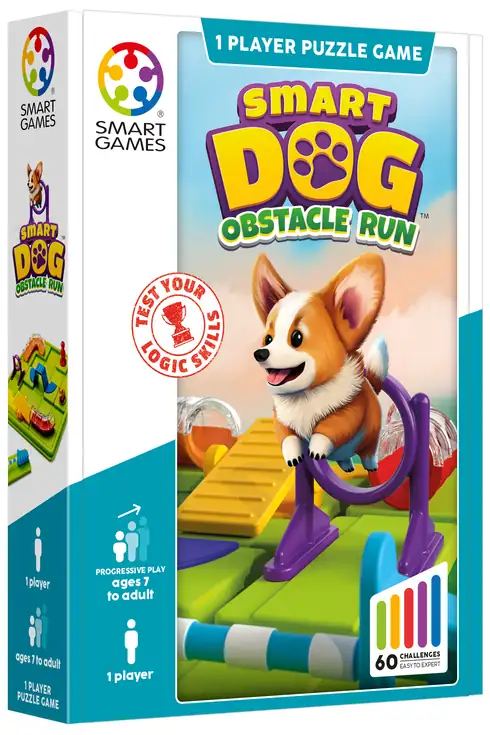
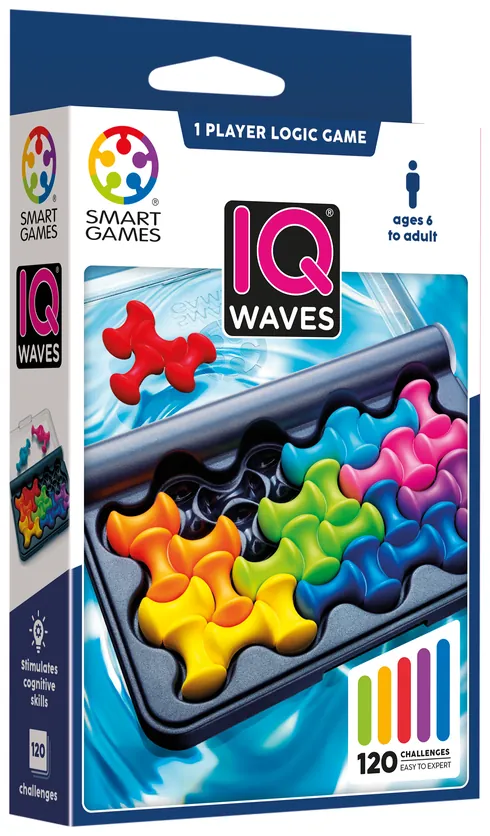
Smart Dog (from age 7, 1 person, flexible playing time) calls for spatial reasoning, planning ahead and cognitive flexibility, like Jump In’. In Smart Dog, players build a path to the trainer; in Jump In’, rabbits jump and are at the same time obstacles. Thanks to their board with a lid, both games are suitable for taking on the go. IQ Waves (from age 6, 1 person, flexible playing time) relies on spatial reasoning and problem-solving, because each piece only fits when its waves are oriented correctly. Because it contains small parts, IQ Waves is less suitable for households with toddlers.
Sources
- SmartGames: So hüpft der Hase (publisher’s page, in German)
- SmartGames: Lièvres & Renards (publisher’s page, in French)
- SmartGames: Jump In’ (publisher’s page)
- SmartGames: Jump In’ (publisher’s image)
- My Puzzle Collection: review
- Smart Games & Puzzles: Jump In’
- SmartGames: awards
- Made in Mechelen: Speelgoed van het Jaar 2017 (in Dutch)
- Legebyen: Jump In (Guldbrikken 2018, in Danish)
- Good Play Guide: review
- Go or No Go: parent’s review (in Dutch)
Frequently asked questions
What age is Jump In’ suitable for?
Jump In’ is recommended from age 7. A child is ready when they enjoy puzzling things out on their own and have the patience for the jumping rules. Younger children find parts of the instructions hard to follow.
How long does a game take and how many people can play?
Jump In’ is a game for 1 person and is played solo. The playing time is flexible. The booklet contains challenges at five levels of difficulty; a challenge is solved as soon as all the rabbits are sitting in holes.
What skills can Jump In’ help develop?
The focus is on logic and planning. Each rabbit jumps and is in the way at the same time, and sometimes one serves as a springboard. The hardest challenge requires at least 87 moves. Holding back the obvious move calls for impulse control and flexibility.
Does the game have other names?
Yes. In German, the SmartGames game is called “So hüpft der Hase”; in French, it is called “Lièvres & Renards”. The German edition has the same pieces, and Jump In’ is recommended from age 7.