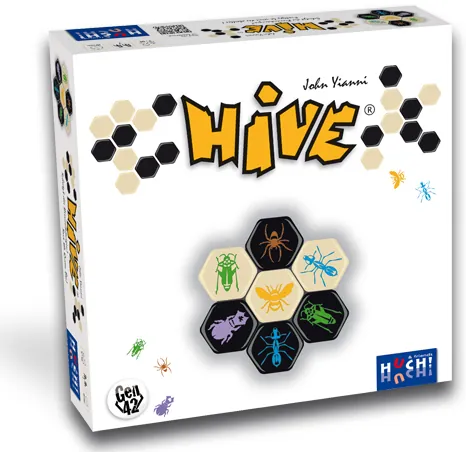
How it plays
Hive needs no board: the hexagonal pieces themselves form the playing area. Players take turns placing one of their eleven pieces or moving a piece already placed. Moving is only allowed once their queen bee is in play (as the fourth piece at the latest), and the hive must never be split apart. The queen moves one step, the beetle climbs onto other pieces and the spider moves exactly three spaces. The grasshopper jumps in a straight line over pieces, and the ant travels as far as it likes. The winner is whoever completely surrounds the opponent’s queen; pieces of both colors count.
What it can help develop
Hive involves no chance. Before every move, players have to check: will the hive split apart if this piece moves? Does the ant fit through the narrow gap? Where will the opponent’s grasshopper jump? This calls for spatial reasoning and planning ahead. Working memory comes in too: the rules for five types of insect and possible sequences of moves, including the opponent’s responses, have to be kept in mind and played through.
Especially suitable for
- Children from age 9 who enjoy puzzling things out or playing chess
- Focused two-player games without chance
- On trips and on vacation: no board needed
Less suitable for
- Children looking for stories, luck or lively commotion
- Unequal experience: the more experienced player usually wins
Our verdict
Hive is a worthwhile choice for focused two-player games with children from age 9 who like puzzle games or chess. It works without luck, the rules are quickly learned, and because no board is needed, it is easy to take on trips. In 2006, it was named “Spiele Hit für Zwei” at the Österreichischer Spielepreis and received the Mensa Select award. Its limitations are its sober, abstract character and the advantage for more experienced players.
Getting started
- Only place pieces in the first few turns: moving is allowed only once the queen is in play, and that has to happen by the fourth piece at the latest.
- Clarify the two basic rules first: the hive must never be split apart, and a piece can only pass through a gap that is wide enough for it.
- Show right at the start that whoever completely surrounds the opponent’s queen wins, regardless of the color of the surrounding pieces. This avoids misunderstandings.
In detail
Variants and player count
According to Wikipedia, each person has eleven hexagonal pieces: a queen, two spiders, two beetles, three ants and three grasshoppers. According to the Hutter Trade product page, the HUCH! edition of the game by John Yianni is intended for 2 people from age 9, needs no board and comes in a storage bag. Gen42 lists 22 pieces and a storage bag, also without a board; according to Hutter Trade, the EAN of the two editions is identical. The English Wikipedia names the One Hive Rule and the Freedom to Move Rule, which concerns narrow gaps.
What reviewers say
According to Wikipedia, Hive won the Österreichischer Spielepreis in 2006 in the category “Spiele Hit für Zwei”; according to Wikipedia, American Mensa chose it as one of the five Mensa Select games in the same year. Reich der Spiele calls the movement mechanism quickly learned, the start easy and the luck factor zero; according to the review, the game has great potential. According to the review, games between players of unequal strength are short, because the more experienced player wins. Shut Up & Sit Down describes simple rules and a portable game that can be played immediately, but that is abstract and sober: more of a challenge than entertainment.
How it compares
Abalone (from age 7, 2 people, about 30 minutes) shares the skill area of logic and planning with Hive and, like Hive, calls for planning ahead and spatial reasoning; there is no chance in Abalone either. Unlike Hive, Abalone needs a hexagonal board with 61 spaces. Against opponents of unequal strength, the more practiced player usually wins in Abalone, as in Hive. Pentago (from age 8, 2 people, about 10 to 15 minutes) shares the skill area of logic and planning, adds flexibility and calls for planning ahead as well as mental rotation. Pentago is a pure duel, and anyone looking for luck or a story is less well served by it, as by Hive. Hive suits children from age 9 who enjoy puzzling things out or playing chess, and focused two-player games without chance; it is less suited to children looking for stories, luck or lively commotion.
Sources
Frequently asked questions
What age is Hive suitable for?
Hive is recommended from age 9. A child is ready when they enjoy puzzling things out, think a few moves ahead and find a game without luck and without a story appealing. Anyone looking for lively commotion or chance will be less happy with it.
How long does a game take and how many people can play?
A game takes about 20 minutes. The game is for 2 people, who play against each other; it is not designed for more. There is no board: the hexagonal pieces themselves form the playing area.
What skills can Hive help develop?
The focus is on logic and planning. Before every move, players have to check whether the hive will split apart if a piece moves, or where the opponent’s grasshopper can jump. Spatial reasoning and working memory are also needed.
What if a child keeps losing against adults?
With no element of luck, the more experienced person usually wins when experience is unequal, and games are then over quickly. For the first few games, the spiders and beetles can be left out, which makes the rules easier.