How it plays
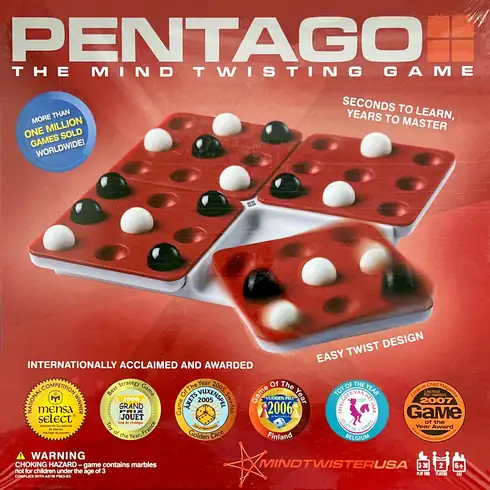
The board consists of four rotating quadrants with nine hollows each. White begins: players place a marble in an empty hollow and turn any quadrant by 90 degrees (both directions are allowed). Whoever is first to have five marbles in a row horizontally, vertically or diagonally wins; if the row is complete straight after placing, no quadrant is turned. If a rotation gives both players a row of five, the game is a draw.
What it can help develop
The key is the rotation: before every move, players have to imagine where the marbles of a quadrant will be after a quarter turn. Will they join up with the adjacent quadrants to form a row? This is mental rotation. Thinking ahead means remembering that the opponent also places and turns, with eight possible rotations; a seemingly harmless marble can suddenly complete a row. Because every rotation changes the position, plans have to be adjusted constantly, which calls for cognitive flexibility.
Especially suitable for
- Children from age 8 who enjoy brain-teasers
- Short duels for a quick break, ideally with a rematch
- Children who find Connect 4 too easy
Less suitable for
- Larger groups: Pentago is purely a duel
- Players looking for luck, theme or story
Our verdict
Pentago is a worthwhile choice for children from age eight who enjoy brain-teasers and for parents looking for a short duel with a quick rematch. Its strength is how easy it is to get into: the rules are quickly learned, and rotating the quadrants turns the familiar game of making rows into a real thinking challenge. Its limitations are the strict two-player format and the absence of luck, theme and story.
Getting started
- Before the first game, clarify the two special cases. If the row is complete straight after placing, no quadrant is turned; if a rotation gives both sides a row of five, the game ends in a draw.
- Alternate who starts from game to game, because with the best play on both sides, the starting player has the advantage.
In detail
Variants and player count
Pentago is designed for exactly two people: the KOSMOS product page for the anniversary edition gives 2 people, an age range of 8 to 99 and 15 minutes. According to the KOSMOS rules, White plays against Black, each side with 18 marbles. A row of five may stretch across two or three of the four rotating quadrants. Besides a rotation that gives both sides a row, the rules name a second way to a draw: if the last move also leaves no row of five, nobody wins. The website perfect-pentago.net calculates how large the choice is even on the first move: 36 spaces times 8 rotations make 288 possible opening moves.
What reviewers say
Brettspiele-Report praises the simple rules and the short playing time, which make it easy to play several games and rematches in a row. At the same time, the review notes that applying the rules well requires an overview of the board and strategy. Reich der Spiele sees the 2007 Kosmos edition as essentially a variant of Connect 4, neither new nor particularly original. However, the same review also writes that the rotation demands more attention and a greater capacity for abstraction: a marble placed in a seemingly harmless spot can become part of a row through a rotation. At Mensa Select 2006, Pentago was one of the five games that received the award.
How it compares
Quoridor (from age 8, 2 to 4 people, 10 to 20 minutes), like Pentago, calls for planning ahead and cognitive flexibility, as well as spatial reasoning. Quoridor is suitable for parent-and-child duels with no luck of the dice at all, but less suited to children who take it personally when they are held up. Blokus (from age 7, 2 to 4 people, 20 to 30 minutes) shares mental rotation with Pentago and suits mixed family groups. Blokus is especially suitable for four-player games in which the board gets crowded, less so for children who take being blocked personally. Pentago remains the short duel for two, ideally with a rematch.
Sources
Frequently asked questions
What age is Pentago suitable for?
Pentago is recommended from age 8. A child is ready when they can imagine what a rotated quadrant looks like. Children who still find this difficult may briefly carry out the rotation for practice and then undo it.
How long does a game take and how many people can play?
A game takes about 10 to 15 minutes. Pentago is a duel for 2 people, and whoever is first to place five marbles in a row wins. That leaves time for a quick second game.
What skills can Pentago help develop?
Pentago can train logic and planning as well as flexibility. The player whose turn it is pictures a rotated quadrant in their head and checks whether a row is formed. Each rotation changes the position, so the plans also change constantly.
Is Pentago just a variant of Connect 4?
One review sees it that way; another praises the simple rules. The difference lies in the rotation, which requires players to keep more of the board in view: an inconspicuous marble can complete a row after a rotation.