How it plays
Depending on the number of players, five to nine factory displays are laid out, each holding four tiles. Taking turns, players take all the tiles of one color from a display; the rest go to the middle of the table, which is also available to choose from. The tiles go into one of the five pattern lines; surplus tiles fall onto the floor and cost points. At the end of the round, one tile from each full pattern line moves to the wall, where adjacent tiles bring more points. As soon as a horizontal row on the wall is complete, the game ends, with bonuses for rows, columns and colors.
What it can help develop
Azul is planning practice with visible consequences: before every pick, players have to judge whether the color fits into a pattern line and what will be left for the others. Impulse control comes in too: the big handful is tempting, but it brings negative points if it does not fit. On the wall, players think spatially: where will the next tile earn points for adjacent tiles? Anyone who keeps an eye on the other players’ boards can see which colors they need.
Especially suitable for
- Children from age 8 who enjoy puzzling things out
- Families on their way to strategy games
- Multilingual groups: language-free components
Less suitable for
- Children who find negative points hard to cope with
- Groups looking for action and laughter
Our verdict
Azul, winner of the Spiel des Jahres 2018, is a worthwhile choice for children from age 8 who enjoy brain-teasers and for families who are growing into strategy games. The rules are quick to explain, and the jury highlighted the depth despite the simple selection mechanism. It is less suited to children who find negative points difficult and to groups looking mainly for action and laughter.
Getting started
- Show the floor rule right at the start: surplus tiles fall onto the floor and cost points.
- At the end of the first round, go through the wall scoring together: on the wall, adjacent tiles bring more points.
In detail
Variants and player count
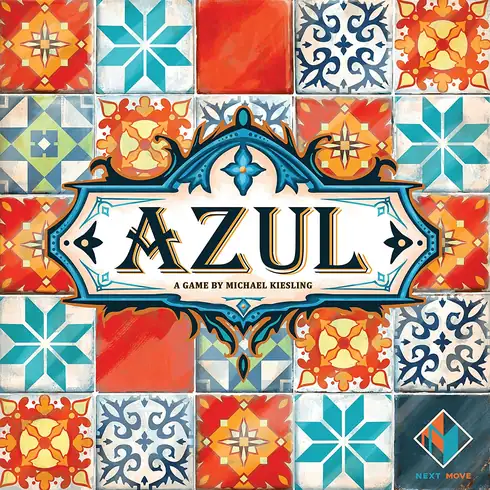
According to the rules help on Board Game Arena, the components include 100 tiles in five colors, 20 of each, and, depending on the number of players, five, seven or nine factory displays with four tiles each. The game ends after the round in which a horizontal row on the wall is complete; there are bonuses of 2, 7 and 10 for a row, a column and a color. On the gray side of the player boards, the wall is blank: players can choose the column freely. Michael Kiesling, for whom it was the third Spiel des Jahres according to t-online, designed Azul; according to Wikipedia, it was illustrated by Philippe Guérin and Chris Quilliams.
What reviewers say
The Spiel des Jahres 2018 jury praises the feel of the tiles and the depth despite the simple selection mechanism; according to t-online, the jury also highlighted the contrast between the plain board and the beautiful tiles. Reich der Spiele calls Azul quick to explain, with a pleasant depth, for frequent players and families; its only objection is that it may be too quiet for many. Spieletest.at praises the high-quality components and how quickly the game can be learned, recommends it to families and tactical players and notes that it becomes harder to plan with more players. In the Deutscher Spiele Preis 2018, Azul came ahead of Gaia Project, and it won the As d’Or against Twin It!, Dice Forge and Flamme Rouge.
How it compares
Karuba (from age 8, 2 to 4 people, about 30 to 40 minutes), like Azul, calls for planning ahead and spatial reasoning, plus cognitive flexibility; in Karuba, nobody waits for their turn. Karuba is less suited to groups looking for interaction and annoying each other. Qwirkle (from age 8, 2 to 4 people, 30 to 45 minutes) shares the skill area of logic and planning as well as planning ahead with Azul and, like Azul, needs no text. Anyone who dislikes depending on the luck of the draw is less well served by Qwirkle. Azul suits children from age 8 who enjoy puzzling things out and families on their way to strategy games; it is less suited to children who find negative points hard to cope with.
Sources
Frequently asked questions
What age is Azul suitable for?
Azul is recommended from age 8. A child is ready when they enjoy thinking about which tiles belong in which pattern line and accept negative points calmly. Anyone looking mainly for action and laughter will get less enjoyment from it.
How long does a game take and how many people can play?
A game takes about 30 to 45 minutes. The game is for 2 to 4 people, who play against each other. According to one review, Azul becomes somewhat harder to plan with additional players.
What skills can Azul help develop?
Azul can help develop logic and planning: thinking ahead, solving problems and adapting strategy. With every pick, players have to choose the color for a suitable pattern line and keep an eye on what is left for the others.
Does Azul work in multilingual groups?
Yes, the components contain no text, so Azul is well suited to multilingual groups. Reviews also describe it as quick to explain.