How it plays
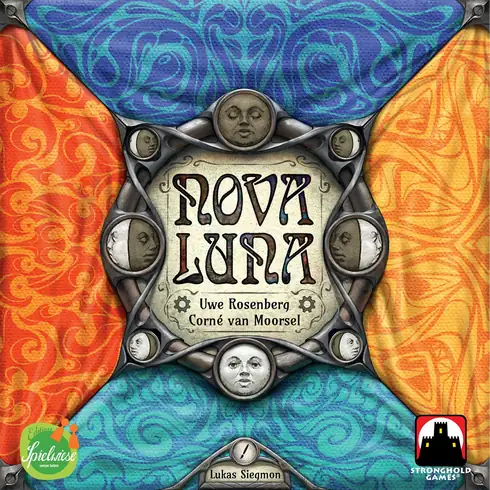
Eleven tiles in four colors lie around the moon clock. Players take one of the three tiles that follow the moon figure clockwise and add it to their own display. Its number (1 to 7) determines how far the player’s token advances on the moon track; the player furthest behind takes the next turn. Each tile sets up to three tasks: particular colors as neighbors, with chains of the same color also counting. Completed tasks are covered with tokens; whoever is first to place all of theirs wins.
What it can help develop
Nova Luna calls for planning ahead: many tasks require tiles that players do not have yet. Anyone who thinks ahead places tiles so that a single tile later completes several tasks. Spatial reasoning is needed for the color chains: nothing counts diagonally. Because only three tiles are available to choose from and the other players change the selection, cognitive flexibility is needed: if the color you want is missing, you have to replan. Tiles with easy tasks cost more time, so players have to weigh things up.
Especially suitable for
- Children from age 8 who enjoy brain-teasers, solo play included
- Quiet two-player games with adults
- Families who like Azul or Patchwork
Less suitable for
- Groups looking for laughter and conversation
- Impatient children in four-player games with players who ponder at length
Our verdict
Nova Luna is a worthwhile choice for children from age 8 who enjoy brain-teasers and for adults who appreciate quiet two-player games and like Azul or Patchwork. The rules are streamlined, and combining the tasks is satisfying. In 2020 it was nominated for the Spiel des Jahres. Its limitations are waiting times with four players, small tokens, a tacked-on theme and the chain rule as a hurdle.
Getting started
- When explaining the chain rule, stress that only tiles adjacent horizontally or vertically count, not diagonally.
- Explain early on that higher numbers on the tiles mean easier tasks but move your token further forward: whoever is far ahead has to wait longer.
In detail
Variants and player count
Nova Luna is intended for 1 to 4 people from age 8, and Edition Spielwiese mentions a solo mode. The publisher gives the playing time as 30 minutes, BoardGameGeek as 30 to 60 minutes. For the first game, the German rules provide 18 tokens for three players and 16 for four.
What reviewers say
The Spiel des Jahres jury nominated Nova Luna in 2020 and saw it as a highly appealing intellectual challenge. In Italy, it was a finalist for the Gioco dell’Anno in 2021. The jury’s review round-up names the chain rule as the biggest hurdle for newcomers, along with small tokens, counting errors and longer downtime with four players. However, the round-up finds the puzzling satisfying and Nova Luna strong as a two-player game. Reich der Spiele and Ringbote consider planning ahead most feasible with two players, and Ringbote describes brooding to the point of analysis paralysis with three or four. Infranken.de reports that Nova Luna also goes down well with children from age 8 and criticizes the tacked-on theme. Numerama finds the rules simple but the game hard to master; according to Numerama, it is tactical with two players and opportunistic with three or four.
How it compares
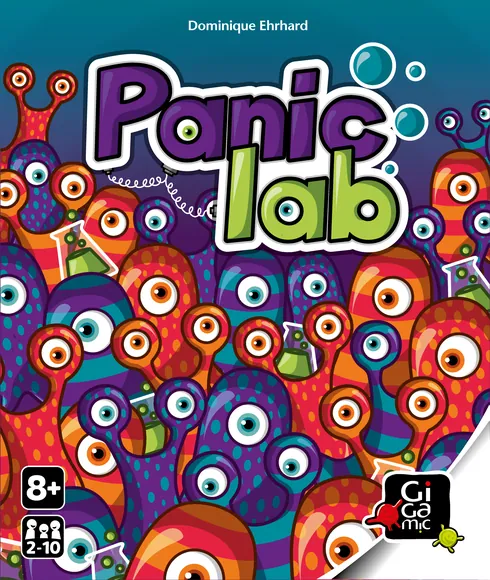
Sequence (from age 7, 2 to 12 people, about 30 minutes) shares planning ahead and cognitive flexibility with Nova Luna (from age 8, 1 to 4 people, about 30 minutes). Sequence suits mixed family groups of up to 12 people and newcomers looking for strategy without long rules; the luck of the draw often plays a part in Sequence. Panic Lab (from age 8, 2 to 10 people, about 20 minutes) shares cognitive flexibility, but calls for visual search and working memory and is aimed at fans of reaction games in large groups. Children who are quickly discouraged under time pressure are less well served by Panic Lab. Nova Luna is the calmer planning game, can also be played solo and is particularly suited to two-player games with adults.
Sources
- Spiel des Jahres: 2020 nominees (in German)
- Edition Spielwiese: Nova Luna (in German)
- BoardGameGeek: Nova Luna
- Nova Luna: rules (PDF, in German)
- Spiel des Jahres: Nova Luna (jury, in German)
- Gioco dell’Anno: 2021 finalists (in Italian)
- Spiel des Jahres: Kritikenrundschau Nova Luna (review round-up, in German)
- Reich der Spiele: review (in German)
- Ringbote: review (in German)
- inFranken.de: hands-on review (in German)
- Numerama: review (in French)
Frequently asked questions
What age is Nova Luna suitable for?
Nova Luna is recommended from age 8. Children who like to plan ahead and can understand the chain rule with some help are ready; according to one review, it can be too much for children aged 8 to 10. Anyone who quickly gets impatient in four-player games is less well served.
How long does a game take and how many people can play?
A game takes about 30 minutes. The game is for 1 to 4 people, playing solo or against each other; according to several reviews, planning ahead works best with two.
What skills can Nova Luna help develop?
It can help develop flexibility as well as logic and planning. Tasks require tiles that only become available later, and because the selection changes, the plan has to be adjusted when the color you want is missing.
How does Nova Luna play with four?
According to several reviews, there are longer waiting times with four, and it becomes harder to plan, especially when players who ponder at length are at the table. The game works best with two.