How it plays
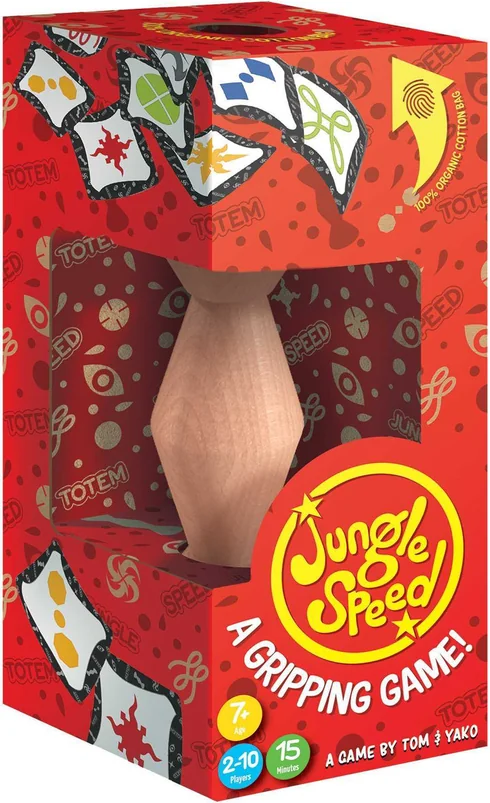
The 70 cards are dealt face down, and the wooden totem stands in the middle. Taking turns, each person turns over their top card with one hand. If two face-up cards show the same symbol (the color does not count), both players grab for the totem; whoever loses takes both face-up piles. Anyone who grabs by mistake has to take all the face-up piles. Arrow cards make everyone grab or turn over cards at the same time. The first to get rid of all their cards wins.
What it can help develop
Jungle Speed resembles a go/no-go task, which neuropsychologists use to measure impulse control: grab or keep still. With each card, players have to check at lightning speed: exactly the same symbol, or only almost the same? This calls for visual discrimination and above all inhibition: the hand is often already on its way when the difference becomes apparent, and has to be stopped. If two other players have a pair, the same applies: hands off. Ignoring the color calls for selective attention, and the arrow cards for switching on the spot.
Especially suitable for
- Children from age 7 and teenagers who love speed
- Large groups of up to ten people, including on the go
- Boisterous children who practice putting on the brakes through play
Less suitable for
- Children who are quickly overwhelmed by hectic play and noise
- Younger children against nimble adults: an uneven pace
Our verdict
Jungle Speed is a worthwhile choice for large, lively groups with children from age 7 and teenagers who love speed. Up to ten people can play, and boisterous children practice putting on the brakes through play. In 2003, it received the “Spiele Hit für Viele” award in Austria. Its limitations are the hectic pace, a lot of luck and games that can drag on; younger children stand little chance against nimble adults.
Getting started
- Reveal cards one player at a time, using only one hand; in a duel, only the two people involved grab for the totem.
- Show beforehand what happens after a wrong grab: anyone who grabs by mistake or knocks the totem over takes all the face-up piles.
- Turn over a few cards slowly and show that only the symbol counts, not the color. With similar shapes, it is easy to grab for the totem too early.
In detail
Variants and player count
According to the publisher, the current Zygomatic edition is intended for 2 to 10 people from age 7; the publisher gives the playing time as 15 minutes. The contents are 70 cards, a wooden totem and a cotton bag. The designers are Thomas Vuarchex and Pierric Yakovenko; according to the French Wikipedia, earlier editions of the game, which was created in 1991, had 80 cards. Arrow cards change the course of play: if the arrows point inwards, everyone grabs for the totem; if they point outwards, everyone turns over a card at the same time. According to the rules, in a dispute whoever has more fingers on the totem wins; violence is forbidden.
What reviewers say
Cliquenabend considers the game suitable for young and old and praises the little bag for taking along; according to the review, the luck factor is high, and play is hectic and often loud. Stubenzocker (2026) reports funny moments because players grab for the totem too quickly when shapes are similar, and praises the bag for taking along; the constant hectic pace and long games are criticized there. Ludovox calls the game very simple and sees it as a game of speed and observation. According to Wikipedia, Jungle Speed received the “Spiele Hit für Viele” award in Austria in 2003.
How it compares
Avocado Smash (from age 6, 2 or more people, about 10 minutes) calls for perception and speed, like Jungle Speed (from age 7, 2 to 10 people, about 15 minutes). Jungle Speed also shares the skill area of impulse control with Avocado Smash: in both, the point is to grab or to keep still. Avocado Smash adds numbers and arithmetic, because players count to 15. Quick Cups (from age 6, 2 to 4 people, about 15 minutes) also calls for perception and speed, like Jungle Speed, and adds fine motor skills and flexibility, because children race to stack cups to match the pictures on the cards. Children who are sensitive to noise are less well served by all three: in Jungle Speed, the hectic pace and the noise overwhelm some children; in Quick Cups, the cups rattle and a bell rings in every round; and Avocado Smash, too, is less suited to children who are sensitive to noise.
Sources
- Zygomatic: Jungle Speed (publisher’s page, in German)
- Zygomatic: Jungle Speed (publisher’s page, in French)
- Zygomatic: Jungle Speed rules (PDF)
- Wikipedia (French): Jungle Speed
- Wikipedia (German): Österreichischer Spielepreis – Preisträgerliste
- Wikipedia (German): Jungle Speed
- Cliquenabend: review (in German)
- Stubenzocker: review (in German)
- Ludovox: review (in French)
Frequently asked questions
What age is Jungle Speed suitable for?
Jungle Speed is recommended from age 7. A child is ready when they can cope with hectic play and noise, look closely and stop their hand at the right moment. Younger children are at a disadvantage against nimble adults, because the pace is uneven.
How long does a game take and how many people can play?
A game takes about 15 minutes, although one review says that games can sometimes be long. The game is for 2 to 10 people, who play against each other, and the first to get rid of all their cards wins.
What skills can Jungle Speed help develop?
It can help develop perception and speed as well as impulse control. With each new card, players have to work out whether the symbol is exactly the same or only similar. Sometimes the hand starts too early, and then it still has to be stopped.
Is Jungle Speed noisy and hectic?
Yes, things often get loud and hectic. Children who are quickly overwhelmed by noise are better off with other games. On the other hand, according to one review, there is a lot of laughter when someone grabs for the totem too early.