How it plays
Eight closed bags lie on the table, each containing a small wooden toy. A card is turned over to show which one players are looking for. After the starting call “Fiddle Faddle!”, everyone feels one bag after another at the same time, without looking inside. Anyone who thinks they can feel the piece opens the bag: if it matches the outline on the card, they win the card; otherwise they are out for this round. Whoever has the most cards wins.
What it can help develop
At its core is recognizing objects by touch alone. Through the bag, the child feels the outline, edges and size, puts them together into a whole and compares it with the picture on the card. This translation between touch and sight is harder than it looks. Because a wrong guess costs the round, it pays not to open a bag too hastily. Children who describe what they feel practice words for shapes.
Especially suitable for
- Children aged 4 to 6 who like feeling and rummaging
- Short games for two with a parent
- Mixed-age groups: older children feel with one hand
Less suitable for
- Children who quickly get frustrated in the scramble
- Older school-age children: ten wooden pieces soon become familiar
Our verdict
Fiddle Faddle! is a worthwhile choice for children from age 3 who like reaching into bags and feeling objects, including for a short game with just one parent. Feeling the pieces and comparing them with the picture on the card are at its core, and the rules describe ways to adjust the difficulty for mixed-age groups. Its limitations are that the base game is turbulent and that older school-age children soon know the ten wooden pieces.
Getting started
- Make clear beforehand that nobody looks into the bags and nobody takes a bag out of someone else’s hands.
- With mixed ages, let the older children feel with one hand only.
- Shout the starting call “Fiddle Faddle!” together so that everyone starts at the same time.
In detail
Variants and player count
According to the publisher, the current HABA edition (item number 1304508001) is for 2 to 4 people from age 3; the designer is Heinz Meister, and the illustrations are by Christine Faust. The box contains 8 magic bags, 10 wooden pieces, 10 small cards and 10 blank cards; the game is played with 8 wooden pieces in 8 closed bags. According to the rules, everyone feels at the same time without looking inside. The rules announce that things will get quite turbulent and suggest a calmer variant to start with, in which players feel the bags one after another. To make it easier, the rules suggest 5 to 6 clearly distinguishable pieces. To make it harder, they suggest using only one hand (with mixed ages, the older children feel with one hand) and a variant with players’ own objects, such as a cork, a coin or a pine cone, on blank cards.
What reviewers say
No independent review of the game is listed. HABA calls it a fun educational game, and the Swiss toy library in Teufen lists it as an educational game. The rules say that recognizing the shape by touch is not that easy at all. No award is listed for the game itself; according to the database on spiel-des-jahres.de, designer Heinz Meister was nominated for the Kinderspiel des Jahres 2002 with “Bärenstark”.
How it compares
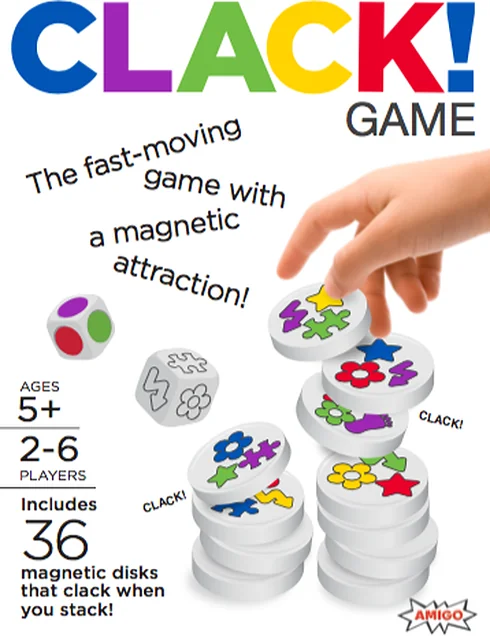
Clack! (from age 4, 2 to 6 people, about 10 minutes) and Fiddle Faddle! share the skill area of perception and speed; the profile of Fiddle Faddle! also includes language. Socken Zocken (from age 4, 2 to 6 people, about 10 minutes) shares the skill area of perception and speed with Fiddle Faddle! and, like Fiddle Faddle!, calls for impulse control. In both games, everyone searches at the same time. Fiddle Faddle! suits children aged 4 to 6 who like feeling and rummaging and short games for two with a parent; it is less suited to children who quickly get frustrated in the scramble and to older school-age children.
Sources
Frequently asked questions
What age is Fiddle Faddle! suitable for?
The recommended minimum age is 3. Children who like reaching into bags and feeling objects are ready. Older school-age children soon know the ten wooden pieces, which limits the appeal for them.
How long does a game take and how many people can play?
A game takes about 5 to 10 minutes. The game is for 2 to 4 people, who play against each other, and whoever has the most cards at the end wins. Because it is so short, a game with just one parent also works.
What skills can Fiddle Faddle! help develop?
It can help develop perception and speed as well as language. Children feel the shape of a piece through the fabric and compare it with the picture on the card; anyone who describes aloud what their fingers feel collects words for shapes.
Does the game get very turbulent?
In the base game, yes, because everyone searches at the same time. The rules therefore recommend a calmer variant to start with, in which the bags are felt one after another. This suits children who quickly lose patience in the commotion.