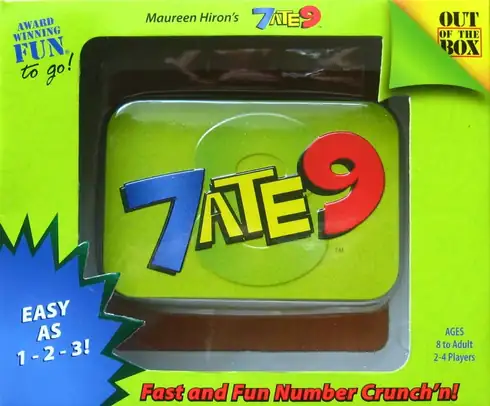
How it plays
Each player has four cards in hand and a face-down pile; one card lies face up in the middle. Everyone plays at the same time and can draw at any time. Each card shows a value (1 to 10) and a number: ±1, ±2 or ±3. A card fits if its value equals the top card’s value plus or minus the top card’s number: a 2 or an 8 fits on a 5 with ±3. After 10 comes 1, and before 1 comes 10. Anyone who plays too late takes their card back. The first player to get rid of all their cards wins.
What it can help develop
Every card played sets everyone the same task: work out the two matching values, hold them in working memory and then search their own hand for them while others are already playing. This calls for mental math with small numbers as well as processing speed. Cognitive flexibility comes in too: every new card makes the solution just found obsolete. The game requires confident addition and subtraction and lets players apply them under time pressure.
Especially suitable for
- School-age children who are confident adding and subtracting up to 10
- Fans of frantic card games such as Ligretto
- Short games for a spare moment, including as a tournament
Less suitable for
- Children who freeze under time pressure
- Groups with big differences in speed, such as adults against eight-year-olds
Our verdict
The game 7 Ate 9 is a worthwhile choice for school-age children who can add and subtract confidently up to 10 and enjoy frantic card games. The rules are understood within a few minutes, games are short and mental math is practiced along the way. Its limitations are that fast calculators have an advantage, that play comes to a standstill when no card fits and that, according to one review, the appeal quickly wears off.
Getting started
- Before the first game, make clear that only one card is played at a time and its value is called out loud; anyone who plays too late takes the card back.
- Remind players that they may draw one card at a time whenever they like and that there is no hand limit.
- Play several short rounds as a tournament: cards left over count as penalty points at the end.
In detail
Variants and player count
According to the publisher, AMIGO, the game idea is by Maureen Hiron, and the German edition consists of 73 cards. According to the rules (version 1.6, 2016), the cards show a value from 1 to 10 and a number: ±1, ±2 or ±3. Everyone plays at the same time with four cards in hand, draws at any time and calls out the value aloud; anyone who is too slow takes the card back. After 10 comes 1, and before 1 comes 10; for a tournament, the rules provide penalty points for cards left over.
What reviewers say
Reich der Spiele calls the basic principle wonderfully simple and the games quick; according to the review, even children who are not keen on arithmetic had fun. In its view, the game is something for fans of frantic games such as Ligretto, less so for fans of calm card-shedding games. Sofahelden writes that the rules are understood in under two minutes and calls the game entertaining; in its view, it gets difficult when others play in between. Standstill is criticized several times: spieletest.at experienced it often in test rounds, Brettspielbox writes that it hampers the flow of play, and Superfred sees it in almost every round. Brettspielbox sees adults at an advantage over 8- to 10-year-olds; spieletest.at considers the age recommendation of 8 bold, because the range below 1 confuses children who are less confident at arithmetic.
How it compares
The game 5-Minute Dungeon (from age 8, 2 to 5 people, about 5 to 30 minutes) shares the age and the skill area of perception and speed with 7 Ate 9. The profile of 5-Minute Dungeon also includes cooperation, and the profile of 7 Ate 9 includes flexibility as well as numbers and arithmetic. SET (from age 6, 1 to 8 people, about 20 minutes) shares perception and speed as well as flexibility with 7 Ate 9; in SET, players search for a rule by which two cards determine the third. The game 7 Ate 9 suits school-age children who are confident adding and subtracting up to 10 and fans of frantic card games; children who freeze under time pressure are less well served.
Sources
Frequently asked questions
What age is 7 Ate 9 suitable for?
The recommended minimum age is 8. School-age children who can add and subtract confidently up to 10, including the step from 10 to 1, are ready. One review considers this age ambitious; children who freeze under time pressure find it harder.
How long does a game take and how many people can play?
A game takes about 15 minutes. The game is for 1 to 4 people. With two or more, everyone plays against each other at the same time, and the first to get rid of all their cards wins. Reviewers praise the short games.
What skills can 7 Ate 9 help develop?
It can help develop perception and speed, flexibility as well as numbers and arithmetic. For example, the 2 and the 8 fit on a 5 with ±3, and because every new card makes the solution just found invalid, players have to keep rethinking.
Is the game hectic?
Yes: reviews describe a pure speed game with no quiet phases, close to Ligretto. Anyone who prefers to lay down cards calmly is less well served here.