How it plays
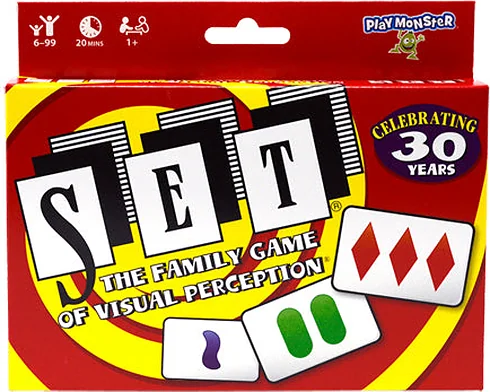
Each of the 81 cards shows one to three identical symbols. Four features vary: number, shape (oval, diamond, wave), color (red, green, purple) and shading (empty, striped, solid). Twelve cards lie face up. Three cards form a “set” if each feature is either the same on all of them or different on all of them. Everyone searches at the same time; whoever sees one calls “Set!” and takes it. If nobody finds one, three more cards are added. A false call costs a point; when the draw pile is empty, whoever has the most points wins.
What it can help develop
SET is visual search guided by a rule: the eyes scan twelve cards, check four features one by one and recognize patterns of “same” and “different”. One thing helps: two cards determine the third unambiguously (red and green require purple), and this third card stays in working memory during the search. Switching between the two principles calls for cognitive flexibility; in a study on perception, similarities were recognized faster than consistent differences. On top of this comes impulse control: check all the features first, then call.
Especially suitable for
- School-age children from age 6 who enjoy puzzling and comparing
- Multi-generation groups: experienced children keep up well
- Playing alone: the rules include a solo variant
Less suitable for
- Children with red-green color blindness
- Children who freeze under time pressure
Our verdict
SET is a worthwhile choice for school-age children who like tracking down patterns and for multi-generation groups in which experienced children keep up well. Its strength: a single clear rule by which everyone searches at the same time, and it can also be played alone as a solo game. Its limitations are the plain, abstract images, the unchanging flow of play and red-green color blindness.
Getting started
- For the first few games, use the mini version from the original rules without the shading feature: 27 cards, nine of which lie face up. After that, shuffle the whole deck.
- Show the principle with an example: two cards lead to exactly one third card that completes the set.
- Before the first game, practice alone with the solo variant to get to know the four features.
In detail
Variants and player count
SET was designed by Marsha Jean Falco; German editions were published by F.X. Schmid in 1995, Ravensburger in 2001 and Amigo in 2013, and PlayMonster has held the worldwide rights since 2019. The Amigo edition is listed for 1 to 8 people and contains 81 cards. The official PlayMonster rules include a solo rule and, to get started, use only the 27 cards with solid symbols, nine of them face up; after that, all the cards are shuffled in. From 2013, Amigo organized German championships; in 2016, an eleven-year-old won.
What reviewers say
SET received the Mensa Select award in 1991 and took ninth place in the Deutscher Spiele Preis 1995. The US magazine Games praised it in February 1992 as an original game of perception and logic that is a fascinating challenge both solo and in competition. Reviewing the 2013 Amigo edition, Reich der Spiele criticizes the images as too plain and abstract and the flow of play as too monotonous and always the same. A perception study by Jacob and Hochstein (2008) found that sets based on sameness are preferred and recognized faster than sets based on differences, and that practice improves performance.
How it compares
The game 5-Minute Mystery (from age 8, 1 to 6 people, about 5 to 30 minutes) covers the skill areas of perception and speed as well as logic and planning, and it can also be played alone. SET shares both of these areas and the option of playing alone. In 5-Minute Mystery, the core is visual search under time pressure, plus coordinating as a team; as with SET, children who quickly freeze under time pressure are less well served there. Jungle Speed (from age 7, 2 to 10 people, about 15 minutes) shares the area of perception and speed and, like SET, calls for impulse control. In SET, players first check all the features and then call; in Jungle Speed, they grab or keep still. Jungle Speed can handle large groups of up to ten people; children who are quickly overwhelmed by hectic play and noise are less well served there.
Sources
- PlayMonster: SET rules (PDF, in English, French and Spanish)
- Wikipedia (German): Set (Spiel)
- Wikipedia (German): Deutscher Spielepreis
- Wikipedia: Mensa Select
- Wikipedia: Set (card game)
- Reich der Spiele: review (in German)
- Amigo blog: tournaments, SET champion 2016 (in German)
- Jacob and Hochstein 2008: perception study on SET (Perception & Psychophysics)
Frequently asked questions
What age is SET suitable for?
SET is recommended from age 6. A child who likes comparing and still checks all four features under pressure before calling is ready. For children with red-green color blindness, the game becomes difficult.
How long does a game take and how many people can play?
A game takes about 20 minutes. The game is for 1 to 8 people. When playing together, everyone searches at the same time and competes for sets, and a false call costs a point; for playing alone, there is a solo variant.
What skills can SET help develop?
SET can help develop perception and speed, logic and planning as well as flexibility. The eyes check twelve cards for four features, and two cards always determine the third: for color, for example, red and green require purple. In the process, players switch between “all the same” and “all different”.
What if a child freezes under time pressure?
Searching competitively can slow children down when they are under pressure. To get started, the original rules provide a mini version with only 27 cards, and a solo variant allows practice without opponents.