How it plays
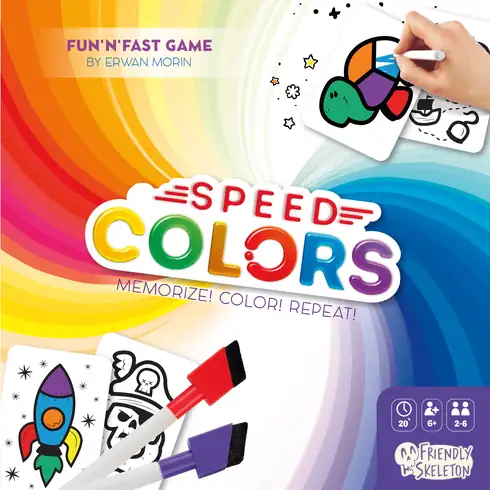
Each card shows a picture made up of six areas: black and white on the front, in color on the back. On “three”, everyone turns their card over and memorizes the colors for as long as they like; once it is turned back, there is no second look. Players color in with dry-erase markers, and there is only one marker of each color. Whoever is finished calls “Stop”; the others only finish the area they have started. An area colored correctly scores two points, one in the wrong color scores one, and an incomplete area or one colored over the edge scores none. After four rounds, the highest score wins.
What it can help develop
At its core is memorization: which color goes where has to stay in working memory while the hand colors in and others reach for the markers. Anyone who looks too briefly has to guess, and anyone who looks too long loses time: children have to judge their own memory. Staying within the lines, even though “Stop” may ring out at any moment, calls for fine motor skills and impulse control. Before each further round, the player with the fewest points swaps two marker caps; players have to remember the swap instead of trusting the color of the cap.
Especially suitable for
- Children from age 6 who enjoy coloring in
- Families with children of different ages
- Siblings playing on their own
Less suitable for
- Children who often color over the edges
- Adult-only groups: the appeal tends to fade
Our verdict
Speed Colors is a worthwhile choice for families whose children from age 6 enjoy coloring in, and for siblings who also play among themselves. Its strengths are the mix of memorizing and coloring in and a very simple rule. Its limitations are the markers, whose durability is questioned, and the lower appeal for adults, who react with more reserve than children.
Getting started
- For the youngest players, use the variant in the rules that leaves out swapping the marker caps between rounds.
- If abilities are mixed, have experienced players use the flower side of the scoring card and younger ones the snake side.
- Make clear beforehand: when the card is turned over, players may look for as long as they like, but once it is turned back, there is no second look.
In detail
Variants and player count
According to the game database on spiel-des-jahres.de, Speed Colors by Erwan Morin in the Game Factory edition (distributed by Carletto) is intended for 2 to 5 people from age 5. The edition sold in the USA by Friendly Skeleton is listed for 2 to 6 people from age 6. BoardGameGeek gives 2017 as the year of publication. The components include six markers with a cleaning sponge and 55 picture cards; according to the Italian version of the Game Factory rules, there are also five double-sided scoring cards. Before each further round, the player with the fewest points swaps the caps of two markers; for younger players, the rules suggest a variant without swapping the caps.
What reviewers say
According to spiel-des-jahres.de, Speed Colors was on the recommendation list for the Kinderspiel des Jahres in 2018, and according to the Wiener Spiele Akademie, it was among the 2018 winners of the “Spiele Hit für Kinder”. Alice Riemer in Reich der Spiele (2018) thinks the combination of memory game and coloring game is great but criticizes that the markers do not seem very durable. In her view, swapping the caps can be left out for younger children. Ludovox finds the rule as simple as it can be and notes that children can play among themselves. Meeple Mountain (Justin Bell, 2024, on the new edition from Friendly Skeleton) saw the children very enthusiastic and the adults who played along with mixed feelings. In the reviewer’s view, the game has less long-term appeal than other party games in his household.
How it compares
Match Madness (from age 7, 1 to 4 people, about 20 minutes) shares the skill area of fine motor skills with Speed Colors. The profile of Match Madness also includes logic and planning as well as perception and speed, and the profile of Speed Colors includes memory and impulse control. Bellz (from age 6, 2 to 4 people, about 10 minutes), like Speed Colors, was published by Game Factory and shares fine motor skills and impulse control with Speed Colors. Bellz adds weighing risks, for example when deciding whether to keep fishing or to play it safe. Speed Colors also combines fine motor skills and impulse control with memory and suits families with children of different ages.
Sources
- Spiel des Jahres: Speed Colors (game database, in German)
- BoardGameGeek: Speed Colors
- dV Giochi: Speed Colors rules (Italian version, PDF)
- Wiener Spiele Akademie: Die ausgezeichneten Spiele 2018 (in German)
- Reich der Spiele: Speed Colors (review, in German)
- Ludovox: Les petits joueurs #4 (in French)
- Meeple Mountain: Speed Colors (review)
- Wikipedia (German): Österreichischer Spielepreis, Preisträgerliste
Frequently asked questions
What age is Speed Colors suitable for?
Speed Colors is recommended from age 6. A child who enjoys coloring in and stays within the lines is ready; anyone who often colors over the edge gets no point for that area.
How long does a game take and how many people can play?
A game takes about 15 minutes and is played over four rounds. The game is for 2 to 6 people, who play against each other, and at the end the highest score wins.
What skills can Speed Colors help develop?
Speed Colors can help develop fine motor skills, memory and impulse control. The six colors and their positions have to stay in the player’s head while the hand colors in. At the same time, the hand has to stay within the lines, even though “Stop” can be called at any moment.
Is Speed Colors fun for adults too?
According to one review, children are very enthusiastic and adults more reserved. In adult-only groups, the appeal therefore tends to fade. It works well when children of different ages play together.