How it plays
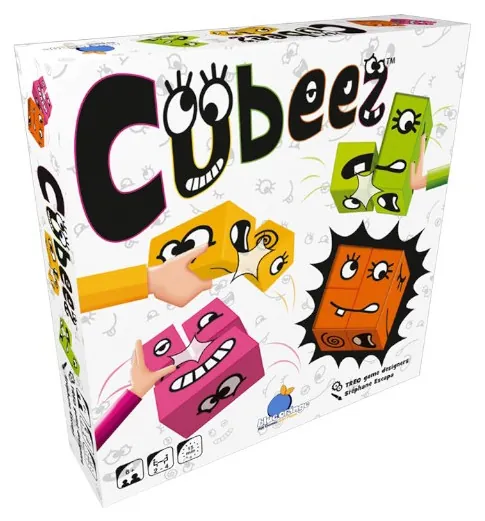
Each player receives three wooden blocks in one color (two cubes and one rectangular block) with eyes, mouths and other facial features on their sides. When a challenge card is turned over, everyone turns and tips their blocks at the same time until, seen from above, they form exactly the face shown; sometimes they have to be stacked. Whoever finishes puts a hand on the pile of cards: if the face is correct, they win the card; otherwise they are out for that round. The first player to have ten cards wins.
What it can help develop
Cubeez calls above all for spatial reasoning: the card shows a flat view from above, which has to be created from three solid blocks. Which side goes on top, which way do the eyes face, what goes on top of what? Anyone who anticipates rotations in their head needs fewer trial moves. Added to this are close observation, because every detail has to be right, and processing speed, because everyone builds at the same time. A quick check before putting a hand down pays off: a wrong face costs the round.
Especially suitable for
- Children from age 6 who enjoy puzzling and building
- Short games for a spare moment
- Children aged 6 to 7 who can barely read yet
Less suitable for
- Children who give up quickly under time pressure
- Adults looking for strategy and depth
Our verdict
Cubeez is a worthwhile choice for children from age 6 who enjoy building and puzzling, even if they can barely read yet, and for short games in a spare moment. Its strength: the game is very easy and is well received by children. Its limitations are the time pressure, which discourages some children, and the limited depth for adults looking for strategy.
Getting started
- Before you start, show that the card is read from above and that the blocks sometimes have to be stacked.
- Before putting your hand down, check all the details once more, because a wrong face means being out for the round.
In detail
Variants and player count
According to Blue Orange, Cubeez contains twelve colored wooden blocks and 50 challenge cards and is intended for 2 to 4 people from age 6. According to the US rules from Blue Orange (© 2018), each color has three blocks, two cube-shaped and one rectangular; the twelve blocks form four sets. Seen from above, the blocks have to match the card, with stacking where needed; the French rules also mention placing blocks side by side. Anyone who puts their hand on the pile of cards but has built incorrectly is out for that round; ten cards bring victory. According to Tlama Games, the designer is Treo Game Designers, and the illustrations are by Stéphane Escapa.
What reviewers say
No independent review of Cubeez is among the sources consulted. Buyer comments at the French retailer Espritjeu call it likeable and very funny and say it is very popular with children, but somewhat less entertaining for adults. The publisher names visual perception, focus and attention as well as fine motor skills as the skills involved. The BoardGameGeek data reproduced by Tlama Games give a complexity of 1 out of 5; Ultra Board Games rates the difficulty as “Very easy”. According to the seller’s description on Amazon, no reading is required.
How it compares
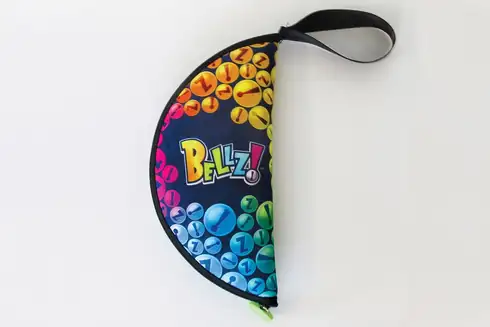
Jenga (from age 6, 1 or more people, about 15 to 20 minutes) shares the skill area of fine motor skills with Cubeez. Jenga calls for controlled force and a sense of touch, where Cubeez calls for spatial reasoning and processing speed. Jenga is less suited to children who are sensitive to noise, because the collapse is loud. Bellz (from age 6, 2 to 4 people, about 10 minutes) also shares fine motor skills and combines them with impulse control: players decide whether to keep fishing or keep their catch. Bellz is less suited to households with small children because of the small parts that could be swallowed. Cubeez suits children from age 6 who enjoy puzzling and building, and short games in a spare moment; it is less suited to children who give up quickly under time pressure and to adults looking for strategy and depth.
Sources
- Blue Orange: Cubeez (publisher’s page)
- Blue Orange: Cubeez rules, USA (PDF)
- Blue Orange: Cubeez rules, Europe (PDF)
- Blue Orange: Cubeez rules (PDF, in French)
- Espritjeu: Cubeez (shop page with buyer comments, in French)
- Tlama Games: Cubeez
- Ultra Board Games: Cubeez
- Amazon.com: Cubeez (seller’s description)
Frequently asked questions
What age is Cubeez suitable for?
Cubeez is recommended from age 6. A child is ready when they enjoy building a face out of blocks to match a flat view from above and can cope with time pressure; reading is not necessary. Anyone who gives up quickly under time pressure finds it hard at first.
How long does a game take and how many people can play?
A game takes about 15 minutes. The game is for 2 to 4 people, who play against each other; everyone builds at the same time, and the first to collect ten cards wins.
What skills can Cubeez help develop?
It can help develop fine motor skills, logic and planning as well as perception and speed. Only the view from above can be seen on the card; anyone who runs through rotations in their head beforehand needs fewer attempts, and every detail of the eyes and mouths has to be right.
Is Cubeez fun for adults too?
Only to a limited extent: buyer comments describe it as popular with children but less appealing for adults. With a complexity of 1 out of 5 according to BoardGameGeek, it offers hardly any strategy.