How it plays
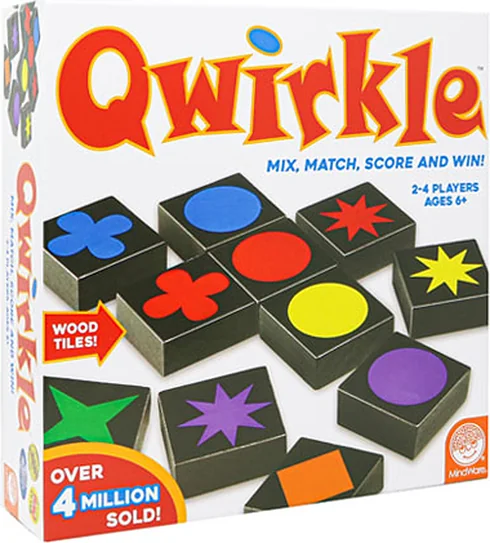
The bag holds 108 wooden tiles: six shapes in six colors. Each player keeps six tiles hidden from the others. Taking turns, players add tiles in a line to those already on the table or exchange some. Each line shares one attribute: the same color with different shapes or the same shape in different colors. Each tile in a line that has been added to scores one point; a Qwirkle, a complete line of six, earns six bonus points. Once the bag is empty, the game ends as soon as someone has placed all their tiles. The player with the most points wins.
What it can help develop
Qwirkle requires players to keep track of two attributes at once: one of them must be the same throughout the line, while the other may never repeat. At intersections, a color line and a shape line often meet: this switch in the sorting rule calls for cognitive flexibility. Pattern recognition is needed when scanning the growing layout: where does a tile count in two lines? A line of five calls for foresight and impulse control: it scores points but opens up a Qwirkle for others.
Especially suitable for
- School-age children who enjoy sorting and puzzling things out
- Groups spanning generations: luck partly offsets experience
- Families who like calm tile-laying games without text
Less suitable for
- Children with color vision deficiency: some colors look alike
- Puzzlers who dislike depending on the luck of the draw
Our verdict
Qwirkle is a worthwhile choice for families with school-age children who like relaxed tile-laying games in which nothing has to be read. Its strength: the rules can be explained in a few minutes, and when placing tiles, players have to keep two attributes in mind at once. Its limitations are some colors that are hard to tell apart in dim light, the luck of the draw and the lack of a score track.
Getting started
- Make sure there is good light, because blue and purple are hard to tell apart in poor lighting.
- Use an example to show that a tile touching two lines scores points for both lines.
- Lay lines of five with care: they score points but can open up a Qwirkle for the next player.
In detail
Variants and player count
According to the publisher, the current Schmidt edition (item number 49014) is intended for 2 to 4 people from age 8 and takes 30 to 45 minutes. That edition contains 108 large wooden tiles; according to the rules (2019 edition), there are 36 designs, each appearing three times, plus a bag. Players draw 6 tiles face down, add tiles that share an attribute in a line or exchange 1 to 6 tiles; a line of six, called a Qwirkle, earns 6 bonus points. The rules advise caution with lines of five and mention paper and pen for keeping score. According to Wikipedia, the first edition from 2006 is by MindWare.
What reviewers say
The Spiel des Jahres jury, which gave Qwirkle the award in 2011, calls it an almost self-explanatory tile-laying game in which luck meets foresight and tactics; according to the jury, the wooden tiles are pleasant to handle. According to Wikipedia, 2011 also brought the Austrian “Spiele Hit für Familien” and a nomination for the French As d’Or. Reich der Spiele finds it quick to explain and quick to play and praises the great quality of the tiles; according to the review, weaker players stand a good chance thanks to the luck of the draw. Spieletest.at praises the few rules and decorative wooden tiles, but criticizes that red and orange are not always easy to tell apart and that there is no score track. Brettspiele-Report says that blue and purple are hard to tell apart in poor light and sees this as a problem for people with color vision deficiency. Cliquenabend criticizes the luck factor when drawing new tiles.
How it compares
Azul (from age 8, 2 to 4 people, about 30 to 45 minutes) and Chess (from age 8, 2 people), like Qwirkle (from age 8, 2 to 4 people, 30 to 45 minutes), have the skill area logic and planning. Qwirkle adds perception and speed as well as flexibility. Chess has no element of chance, whereas in Qwirkle the luck of the draw evens out experience a little. Azul is less suited to children who find penalty points hard to cope with, Chess to groups of more than two people, and Qwirkle to children with color vision deficiency.
Sources
- Spiel des Jahres: Qwirkle (jury, in German)
- Schmidt: Qwirkle (publisher’s page, in German)
- Schmidt: Qwirkle rules (PDF, in German, French and Italian)
- Wikipedia (German): Qwirkle
- Wikipedia (German): As d’Or – Jeu de l’Année
- Reich der Spiele: review (in German)
- Spieletest.at: review (in German)
- Brettspiele-Report: review (in German)
- Cliquenabend: review (in German)
Frequently asked questions
What age is Qwirkle suitable for?
Qwirkle is recommended from age 8. A child is ready when they enjoy sorting and can reliably tell colors and shapes apart. With color vision deficiency, some colors are hard to distinguish.
How long does a game take and how many people can play?
A game takes 30 to 45 minutes, and the game is for 2 to 4 people, who play against each other. Play ends when the bag is empty and someone places their last tile; the player with the most points wins.
What skills can Qwirkle help develop?
Qwirkle can train logic and planning as well as perception and flexibility. At intersections, color lines and shape lines meet, so the sorting rule changes; players also have to recognize which tiles count more than once.
What do you need apart from the box?
A pen and paper, because no score track is included. A child who enjoys arithmetic can take care of keeping score and practices mental math at the same time.