How it plays
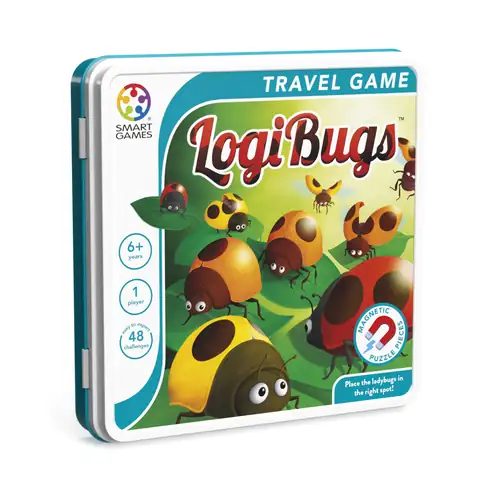
The metal tin doubles as a board with 3 × 4 squares, and there are twelve magnetic ladybugs: five red, four orange and three yellow, numbered by the spots on their backs. In the edition reviewed, the booklet offers 48 challenges at four levels; for some squares, each one reveals the color, the number of spots or even the complete beetle. All twelve go on the board, each color as a chain: the 1 next to the 2, the 2 next to the 3, horizontally or vertically. Each challenge has exactly one solution.
What it can help develop
The core is drawing conclusions: if the yellow one-spot beetle is in a corner, its two-spot partner has only two neighboring squares, and if one of them is taken, its place is settled. Such conclusions call for deductive reasoning: combining and ruling out. Added to this is planning in a confined space: a long red chain must not cut off the space the other chains need. At the Master level, some squares only give the number of spots, and then working memory has to hold several assumptions at once.
Especially suitable for
- Children from age 6 who like puzzling things out on their own
- Car rides and waiting times: the beetles are magnetic
- First steps toward logic puzzles such as sudoku
Less suitable for
- Children who prefer playing with others
- Experienced puzzlers: the booklet is soon finished
Our verdict
LogiBugs is a worthwhile choice for children from age 6 who like to puzzle things out independently, and as a compact travel game. The rules are quickly learned, the magnetic beetles stick firmly and the challenges increase in difficulty over four levels. Its limitations are its purely solo nature and a booklet that experienced puzzlers soon finish.
Getting started
- Go through the three types of clue together first. A colored square gives only the color, a white beetle only the number of spots, and a beetle with color and spots shows exactly that beetle.
- Work through the game level by level: as the level rises, the clues become more abstract, and at the highest level some squares reveal only the number of spots.
In detail
Variants and player count
LogiBugs, as the English publisher’s page calls it, came out from SmartGames in 2024; the German edition is called “Käfer Karussell”. The metal tin with its lid serves as a board with 3 columns and 4 rows; there are also twelve magnetic ladybugs, five red, four orange and three yellow, and a booklet of challenges with solutions. The booklet is divided into four levels, Starter, Junior, Expert and Master; at the Master level, some squares only show the number of spots. Beetles of the same color form a chain in which one spot lies next to two and two next to three, in a straight line or at an angle; each challenge has exactly one solution.
What reviewers say
The three personal accounts consulted come from blogs that received a free, discounted or review copy. Roads to Everywhere praises the way the magnetic beetles solve the problem of loose pieces in the car, considers the recommended age of 6 appropriate and, as an adult reviewer, worked through the booklet fairly quickly. Flanders Family highlights that the beetles stick firmly to the metal tin and are easy to grip, and that the rules are easy to remember. The Art Kit Blog reports that children of different ages enjoyed playing and that the challenges were manageable but demanding; the blog compares the game to sudoku.
How it compares
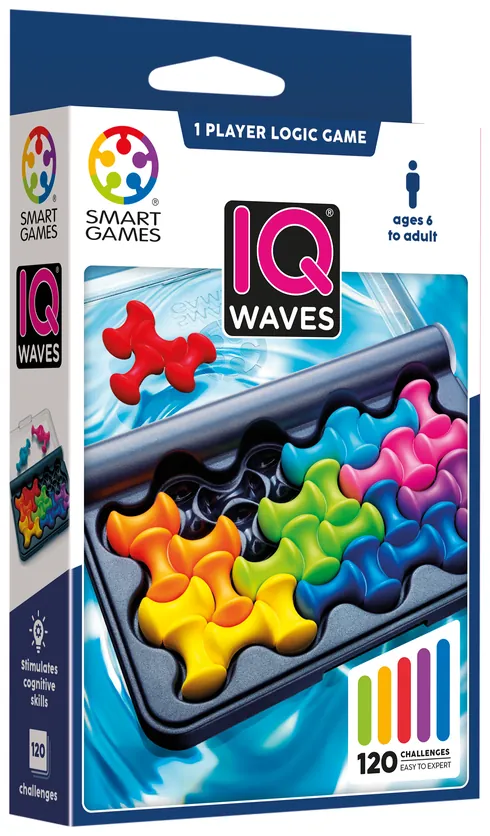
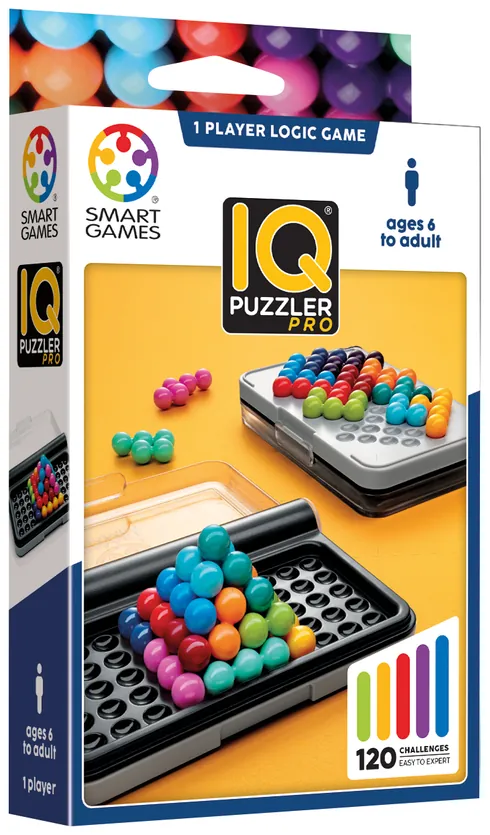
IQ Waves (from age 6, 1 person, flexible playing time) shares the age, logic and planning, and planning ahead in a confined space with LogiBugs. In IQ Waves, a piece only fits when its waves are oriented correctly; because of the small parts, IQ Waves is not suitable for households with toddlers. IQ Puzzler Pro (from age 6, 1 person, flexible playing time) also belongs to logic and planning, but it mainly calls for mental rotation and problem-solving and offers challenges ranging from easy to very tricky. LogiBugs, by contrast, relies on deduction: players work out from the clues where each beetle belongs, and experienced puzzlers soon finish the booklet.
Sources
- SmartGames: LogiBugs (publisher’s page)
- SmartGames: LogiBugs, rules inside the tin lid (image)
- SmartGames: LogiBugs, board and example solution (image)
- SmartGames: LogiBugs, cover of the challenge booklet
- Tania Książka: LogiBugs (retailer data, in Polish)
- Roads to Everywhere: personal account
- Flanders Family: personal account
- The Art Kit Blog: personal account
Frequently asked questions
What age is LogiBugs suitable for?
LogiBugs is recommended from age 6, and one personal account considers this appropriate. It is suitable for children who like puzzling things out alone; anyone who prefers playing with others is less well served by it.
How long does a game take and how many people can play?
LogiBugs is a puzzle game for 1 person. The playing time is flexible, because the challenges in the booklet, divided into four difficulty levels, are solved one at a time and at your own pace.
What skills can LogiBugs help develop?
It can help develop logic and planning. The positions of the beetles have to be deduced from the clues and the chain rule. If a beetle is in a corner, its neighbor in the chain has only a few squares left, which fixes further positions.
Is LogiBugs good for playing on the go?
Yes, it is designed as a travel game: the metal tin serves as both board and storage, and the magnetic beetles stick firmly, so nothing gets lost in the car.