How it plays
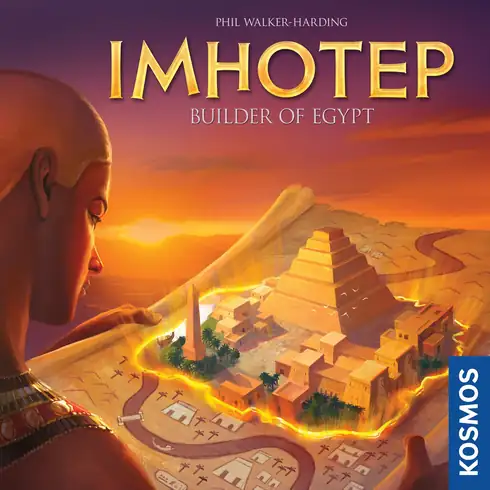
For six rounds, a round card provides four boats of varying sizes. On each turn, a player chooses one action: take up to three stones from the quarry, load a stone onto a boat, send a boat off or play a blue market card. A boat only sails once it carries its minimum load, and anyone may sail it, even without stones of their own on board. At the destination, the stones are placed from front to back at the pyramid, temple, burial chamber or obelisks, or exchanged for cards at the market. Whoever has the most points at the end wins.
What it can help develop
Imhotep calls for weighing up options over just a few moves: which boat, which space, which site? The position on board determines the order in which a stone is placed, and that takes thinking ahead, because some sites score immediately and others only at the end of the round or the game. Because anyone may sail any boat, players have to anticipate the others’ intentions and change their plans. Cognitive flexibility counts for more than a long master plan.
Especially suitable for
- Children from age 10 who enjoy working out tactics
- Families who like playing against each other
- An introduction to tactical games: only four actions
Less suitable for
- Children who dislike being thwarted
- Players who prefer to pursue their own plans undisturbed
Our verdict
Imhotep is a worthwhile choice for families with children from age 10 who enjoy working out tactics and like to compete: with only four actions, it is a good introduction to tactical games. In 2016, it was nominated for the Spiel des Jahres, and the jury highlighted the growing wooden buildings. Its limitations are the limited influence over where the boats go, the abstract feel of the game and being thwarted by others.
Getting started
- First show that stones are placed from bow to stern, that is, from front to back. That is why the position on board already determines the order.
- Explain beforehand when the sites score: the pyramid immediately, the temple at the end of each round, the burial chamber and obelisks only at the end of the game.
- Tell the children that a round ends after the fourth boat has sailed. This makes it easier to judge how many turns are left.
In detail
Variants and player count
The sites have an A side and a B side; Reich der Spiele calls the B sides a professional variant. How much space the boats offer changes from round to round: according to Wikipedia, they hold 1 to 4 stones, and a round card determines which four boats are in play. Each site takes only one boat. A player’s own supply may hold no more than five stones.
What reviewers say
In the vote for the Spiel des Jahres 2016, Imhotep was nominated alongside Karuba; Codenames won. Besides the growing buildings made of easy-to-grip wooden cubes, the jury also highlighted the well-matched components. Brettspielbox appreciates that there are only four actions and that there is hardly any waiting. However, the same review sees only limited influence over the boat journeys and calls the game rather abstract. Reich der Spiele praises the brisk flow of play. Brettspiele-Report describes the interaction as high and criticizes the fact that players constantly have to keep count.
How it compares
Karuba (from age 8, 2 to 4 people, about 30 to 40 minutes) shares the skill areas of logic and planning as well as flexibility with Imhotep. So does The Quest for El Dorado (from age 10, 2 to 4 people, about 45 to 60 minutes). Karuba already suits children from age 8 and families who want to play without direct conflict. Anyone looking for interaction and getting in each other’s way will find less of it in Karuba. The Quest for El Dorado introduces deck-building, but requires patience during the slow start and a large table. With only four actions, Imhotep offers an introduction to tactical games for families who like playing against each other.
Sources
Frequently asked questions
What age is Imhotep suitable for?
Imhotep is recommended from age 10. A child is ready when they enjoy working out tactics and stay calm when others thwart their plans. Children who dislike being thwarted will quickly get annoyed here.
How long does a game take and how many people can play?
A game takes about 40 minutes and is played over six rounds. The game is for 2 to 4 people, who play against each other, and whoever has the most points at the end wins. According to one review, there is hardly any downtime.
What skills can Imhotep help develop?
It calls for logic and planning as well as flexibility. Where a stone sits on board determines the order in which it is placed, so players have to think ahead early. Because every player may sail every boat, plans have to be changed again and again.
What if a child dislikes being thwarted?
This is one of the limitations of the game: any player may sail a boat, even without stones of their own on it, and it can be sent to an unrewarding destination. The interaction is considered high; anyone who wants to plan undisturbed is more likely to be dissatisfied.