How it plays
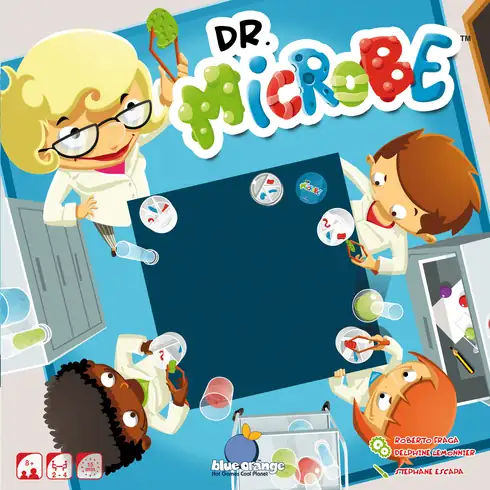
Everyone plays at the same time, each with a Petri dish (one large and three small compartments) and tweezers; the microbes lie in the middle of the table. The challenge card specifies part of the solution, and a rule applies to the empty compartments. The microbe in the large compartment differs in color and shape from the small ones; these have three different shapes, and two of them share a color. Microbes may only be touched with the tweezers. Whoever is finished calls out and has their dish checked; if everything is correct, they win the card. Collecting five cards wins the game.
What it can help develop
What is needed is logical reasoning under time pressure: working out from the card and the rules which microbes are missing. Keeping color and shape in mind at the same time places demands on working memory. Sometimes several solutions fit; players may choose whichever is quickest. On top of this come fine motor skills, using the tweezers in the scramble, and visual search. Anyone who calls out wrongly is out for the round; checking briefly beforehand is a mild exercise in impulse control.
Especially suitable for
- School-age children who enjoy brain-teasers and have a steady hand
- Evenly matched groups, for example at a children’s birthday party
- Families who enjoyed Dr. Eureka
Less suitable for
- Groups whose players have very different levels of experience
- Children who cannot yet pay attention to color and shape at the same time
Our verdict
Dr. Microbe is a worthwhile choice for children from age 8 who enjoy brain-teasers and have a steady hand, and for evenly matched groups, for example at a birthday party. The components invite you to handle them, and the rule is quickly explained. Its limitation lies in the level of difficulty: despite the simple rule, the challenges require brainpower, whoever calls out first is not infrequently wrong, and players of differing experience quickly become frustrated.
Getting started
- Before calling out, check the color and shape of each microbe once more, because a wrong call means being out for the round.
- Where possible, group players with similar experience together, because uneven groups quickly lead to frustration.
In detail
Variants and player count
According to the rule book of the German Pegasus edition (2017), Dr. Microbe is a dexterity game for 2 to 4 people from age 8. It contains 48 microbes and 1 supervirus, 54 challenge cards, 4 pairs of tweezers and 4 small Petri dishes as well as 1 large one. Everyone plays at the same time: players place the pictured microbes by shape and color and fill the empty compartments according to the research rules. The large compartment gets a different color and shape from the three small ones; these hold only different shapes, two of them in the same color. Whoever calls out wrongly is out for the round after the check; the goal is to win 5 challenge cards. Microbes may only be touched with the tweezers. According to Blue Orange, there can be more than one correct solution. According to Cliquenabend, the game was published in 2017 by Blue Orange Games and Pegasus Spiele and is the third game in the “Dr.” series; the first was Dr. Eureka.
What reviewers say
Reich der Spiele praises how quickly Dr. Microbe is explained, mentions the tweezer battles, a high fun factor and its suitability for children’s birthday parties, and considers it best with three or four players. On the critical side, Reich der Spiele says that the game is hard to master, that the first player to call out is not infrequently wrong and that it causes frustration when players are at different levels. H@LL9000 (2018) describes the components with the soft rubber microbes as very inviting and the game as a hectic one. A player’s comment on Ludovox sees the same principle as in Dr. Eureka and Dr. Beaker and considers it more of a dexterity game.
How it compares
Dr. Eureka (from age 6, 2 to 4 people, about 15 minutes) has the same number of players and the same playing time as Dr. Microbe. Dr. Eureka covers logic and planning as well as fine motor skills, but not perception and speed. Make ’n’ Break (from age 8, 2 to 4 people, about 30 minutes) has the same minimum age and the same three skill areas as Dr. Microbe (from age 8, 2 to 4 people, about 15 minutes), but it takes longer.
Sources
Frequently asked questions
What age is Dr. Microbe suitable for?
Dr. Microbe is recommended from age 8. A child who can keep track of color and shape at the same time and stays calm with the tweezers is ready. If this is still difficult, the game is not yet a good fit; the same applies to groups with very different abilities.
How long does a game take and how many people can play?
A game takes about 15 minutes, and the game is for 2 to 4 people, who play against each other at the same time. Whoever is finished calls out and has their dish checked; winning five cards decides the game. Things get especially hectic with three or four players; one review considers this the best player count.
What skills can Dr. Microbe help develop?
It can help develop logic and planning, fine motor skills as well as perception and speed. The missing microbes have to be worked out from the incomplete card and the research rules, and the tweezers require a steady hand in the scramble.
Is there always only one correct solution?
Not necessarily: according to the official rules, there can be more than one correct solution. A wrong call means being out for the round, so a quick check is worthwhile.