How it plays
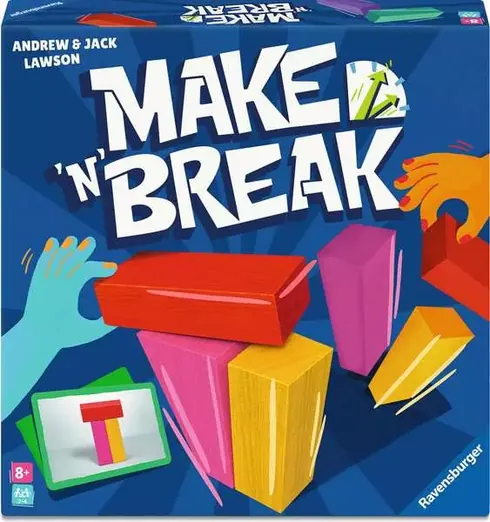
In the new edition reviewed, a referee (not needed with two players) sets up a card showing a structure made of colored wooden blocks. All the other players copy it at the same time, each with eight blocks, and call out when they have finished. The fastest correct build earns 3 points, the next ones 2 and 1. Whoever first reaches space 8 builds with one hand, whoever first reaches space 12 builds with one eye covered. The most points win. Older editions are played with players taking turns to build against the clock.
What it can help develop
The card shows only an illustration, which children translate into three dimensions: which block lies at the bottom, which one stands on its edge? This calls for spatial reasoning, comparing shape and color and, in the race, processing speed. Because a faulty build earns no points, a quick check before calling out that you are done is worthwhile; this is a chance to practice impulse control. Steady hands keep the structure stable; with one eye covered, judging depth is harder.
Especially suitable for
- Children from age 8 who love building and like speed
- Mixed groups: in the new edition reviewed, handicaps slow down the leaders
- For two to four players, about 30 minutes
Less suitable for
- Children who find it hard to cope with losing a race
- Children with color vision deficiency: the colors have to match
Our verdict
Make ’n’ Break is a worthwhile choice for children from age 8 who love building and for mixed groups: the rules are quickly explained and, in the new edition reviewed, handicaps keep the race open. The original was awarded the Schweizer Spielepreis and the Deutscher Lernspielpreis in 2004. Its limitations are the race for children who find defeat hard to bear, and the color perception that matters.
Getting started
- Check once more before calling out: a faulty build earns no points, even if it is finished first.
- With two players, the referee is not needed in the new edition reviewed; play to 20 points then.
In detail
Variants and player count
According to the publisher, the current German edition (Ravensburger 25174) is intended for 2 to 4 people from age 8 and takes about 30 minutes. That edition contains 24 wooden blocks, 60 double-sided cards with 120 builds and 2 handicap tokens, but neither a timer nor dice. Everyone builds at the same time; according to the rules of the new edition, the fastest correct builds earn 3, 2 and 1 points, a wrong build 0. The handicaps are on space 8 (building with one hand) and space 12 (covering one eye); the red side of the cards is somewhat more difficult than the green side. From four people, there is a team variant in which one person describes and the other builds. The 2004 original had a timer and special dice.
What reviewers say
Reich der Spiele calls the game fast and catchy; in that review, the loudly ticking clock and very difficult builds are criticized, and according to the review the game is not for clumsy players. Hall9000 complains about the rattling of the timer and the build time decided by a roll of the dice in the original; according to Hall9000, the structures call for a good eye and a steady hand. Spieletest.at finds the rules absolutely simple and the game thrilling, and calls the dice rolling a chance factor. The current edition has neither a timer nor dice. Poeppelkiste calls it a really good family game in which younger children can join in without any problems. According to Wikipedia, the original received the Schweizer Spielepreis (family games) and the Deutscher Lernspielpreis (elementary school age) in 2004.
How it compares
Tangram (from age 8, 1 person, about 10 to 15 minutes) and DropZone (from age 8, 1 person, flexible playing time) share the skill areas fine motor skills as well as logic and planning with Make ’n’ Break (from age 8, 2 to 4 people, about 30 minutes). Make ’n’ Break also calls for perception and speed. Tangram and DropZone are both solo puzzle games, whereas in Make ’n’ Break everyone races to build at the same time. Make ’n’ Break is less suited to anyone who finds it hard to cope with losing a race; Tangram and DropZone are less suited to families looking for a competitive game or a sociable group.
Sources
- Ravensburger: Make ’n’ Break (publisher’s page, in German)
- Ravensburger: Make ’n’ Break, rules of the new edition (PDF, in German, French and Italian)
- Luding: Make ’n’ Break (game database, in German)
- Wikipedia (German): Schweizer Spielepreis
- Wikipedia (German): Deutscher Lernspielpreis
- Reich der Spiele: review (in German)
- Hall9000: review (in German)
- Spieletest.at: review (in German)
- Poeppelkiste: review (in German)
Frequently asked questions
What age is Make ’n’ Break suitable for?
Make ’n’ Break is recommended from age 8. Children who enjoy building, translate an illustration into a structure and do not lose their enthusiasm after losing a race are ready. It gets difficult with color vision deficiency, because the colors have to match.
How long does a game take and how many people can play?
A game takes about 30 minutes. The game is for 2 to 4 people, who play against each other; everyone copies the build at the same time, and whoever is both correct and fastest earns the most points.
What skills can Make ’n’ Break help develop?
It can help develop fine motor skills, logic and planning as well as perception and speed. For example, an illustration is quickly translated into three dimensions, and steady hands keep the structure stable.
Can children and adults play together?
Yes, reviews praise the fun for children and adults alike. In the new edition reviewed, handicap tokens slow down the leaders: whoever first reaches space 8 builds with one hand, whoever first reaches space 12 builds with one eye covered.