How it plays
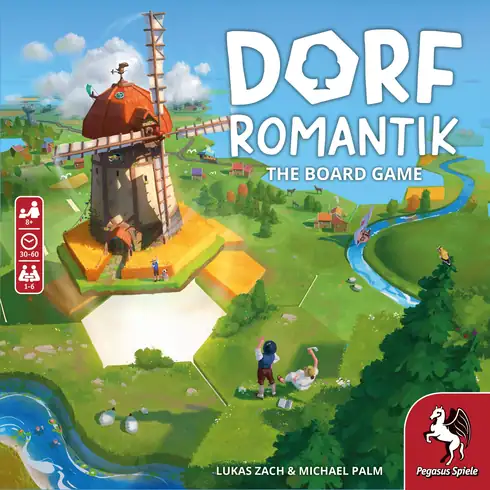
Everyone plays together, aiming for a high score. The active player turns over a hexagonal tile and the group discusses where it should go. Only rivers and train tracks have to connect correctly, while forests, grain fields and villages may border each other freely. Up to three tasks lie face up, for example a village made of exactly five tiles. At the end, points are scored for tasks, completed areas with a flag, the longest river and the longest train track; over several games, the points unlock sealed boxes.
What it can help develop
At its core is planning ahead with numbers: a task only counts with exactly four, five or six tiles. If the village has four and the task calls for five, it must neither grow beyond five nor be closed off at four. Because the upcoming tiles stay face down, replanning is part of the game. Rotating each hexagon calls for visual-spatial processing, and several open tasks at once put a load on working memory. In discussion, everyone practices giving reasons for their ideas.
Especially suitable for
- Children from age 8 who enjoy puzzling things out calmly
- Children who find losing hard
- Parent-and-child pairs and small groups over many evenings
Less suitable for
- Large groups: each player rarely gets a turn
- Children looking for speed, action or competition
Our verdict
Dorfromantik: The Board Game is a worthwhile choice for families in a small group, such as parents with a child, who want to puzzle things out together at a calm pace. There are no losers, and the campaign provides material for many evenings. Its limitations are the luck factor when tiles are turned over and the fading appeal in larger groups, where each player rarely gets a turn.
Getting started
- Only open the sealed boxes when the campaign sheet allows it: the points from several games unlock them bit by bit.
- Start with two or three players, because in larger groups each player rarely gets a turn.
In detail
Variants and player count
According to Pegasus Spiele, Dorfromantik: The Board Game is a cooperative tile-laying game with hexagonal landscape tiles for 1 to 6 people from age 8, and the adaptation of the video game by Toukana Interactive. The designers are Lukas Zach and Michael Palm. Five boxes are sealed at first; according to the rules, the replayable campaign unlocks them via a campaign sheet. According to the rules, only rivers and train tracks have to continue correctly, while forests, grain fields and villages may border each other freely.
What reviewers say
The Spiel des Jahres jury, which gave the game its award in 2023, writes that it takes the pressure off and that players can never lose. According to the jury, the campaign tempts players into new games, and the game is quick to explain. According to Wikipedia, it took second place in the Deutscher Spiele Preis 2023, behind Planet Unknown. In Rezensionen für Millionen, Udo Bartsch describes it as relaxed puzzling that rewards rather than punishes. According to the review, all information is open, it can also be played solo, but the luck factor is not insignificant. On gamesweplay.de, Harald Schrapers calls it calm and free of time pressure, with a playful pull. According to the review, it is designed for 1 to 6 people but is better with two or three; in larger groups, thinking things through together is rarely needed.
How it compares
Azul (from age 8, 2 to 4 people, about 30 to 45 minutes) shares the skill area of logic and planning with Dorfromantik: The Board Game. Like Dorfromantik: The Board Game, Azul calls for planning ahead and spatial reasoning. Azul is less suited to children who find penalty points hard to cope with. Harmonies (from age 10, 1 to 4 people, about 30 minutes) calls for planning ahead and spatial reasoning, like Dorfromantik: The Board Game. In both, a landscape grows, but in Harmonies each person builds on their own player board. Harmonies is less suited to groups looking for a lot of direct interaction. Dorfromantik: The Board Game suits children from age 8 who like to puzzle things out calmly, as well as parent-and-child pairs and small groups over many evenings. In large groups, each player rarely gets a turn, and it is less suited to children looking for speed, action or competition.
Sources
- Spiel des Jahres: Dorfromantik (jury, in German)
- Pegasus Spiele: Dorfromantik (publisher’s page, in German)
- Pegasus Spiele: Dorfromantik rules (PDF, in German)
- Wikipedia (German): Deutscher Spielepreis
- Rezensionen für Millionen: review by Udo Bartsch (in German)
- gamesweplay.de: review by Harald Schrapers (in German)
Frequently asked questions
What age is Dorfromantik: The Board Game suitable for?
Dorfromantik: The Board Game is recommended from age 8. A child who likes to work things out calmly and can keep track of the number of tiles is ready. Children who prefer games that are fast, full of action or competitive will enjoy it less.
How long does a game take and how many people can play?
A game takes about 30 to 60 minutes. The game is for 1 to 6 people and can also be played solo. Everyone plays together, aiming for a high score. Reviews find it most appealing with 2 to 3 people; one advises against more than four.
What skills can Dorfromantik: The Board Game help develop?
It can help develop logic and planning as well as cooperation. A task calls for an exact number of tiles, so the village has to grow in a targeted way, and the group works out together, giving reasons, where a tile should go.
What if a child does not like losing?
Everyone plays as a team for a shared score; there is no opponent. The Spiel des Jahres jury also praised the fact that the pressure is removed because players can never lose.