How it plays
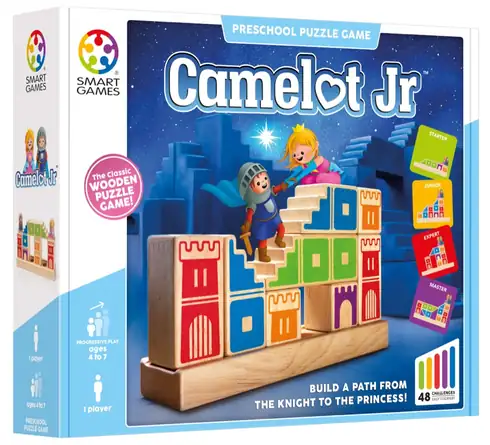
On a wooden base, the knight and the princess have to find their way to each other. For this, there are four towers, three staircases and a bridge. In the edition reviewed, a booklet sets 48 challenges at four levels, from Starter (from age 4) to Master (from age 7). Each challenge shows where the towers and figures stand and which pieces the child has to build in: no more and no fewer. The figures can only walk via the stairs and along the tops of walls; they are not allowed to jump or climb. The solution is on the back.
What it can help develop
The focus is on spatial reasoning: a staircase can be used upright, lying down or turned over as a flat walkway, and the child works through these positions mentally. Because the figures may only set off once everything is in place, the child walks the route in their head beforehand and plans ahead. If there seem to be too many pieces, the surplus wood has to be built in without blocking the way. The child has to move away from the obvious construction plan, which calls for cognitive flexibility.
Especially suitable for
- Children from age 4 who enjoy puzzling and building
- A quiet solo activity without a screen
- Grows with the child up to about age 7
Less suitable for
- Children who only enjoy playing in company
- Anyone expecting many very easy starter challenges
Our verdict
Camelot Jr. is a worthwhile choice for young puzzlers from age 4 who enjoy building, and as a quiet, screen-free activity that grows with the child into school age. The booklet offers challenges at four levels, the wood is considered sturdy, and in 2008 the game received the Super Trophée Flip. Its limitations are that it is a solo game and that, according to a few comments, anyone who values challenges for the very youngest will find too few easy starting points.
Getting started
- Start with Starter and progress level by level: Starter from age 4, Junior from 5, Expert from 6, Master from 7.
- Show the movement rule: the figures only go up via the stairs and walk along the tops of walls; jumping and climbing are not allowed, and nothing moves until everything is built.
- If the child gets stuck, think backwards from the goal, that is, from the solution back to the start.
In detail
Variants and player count
Camelot Jr. is a game for one person, and the SmartGames website gives an age range of 4 to 7. A description on smartgamesandpuzzles.com distinguishes two types of challenge: in some, there seem to be too few pieces, and what is needed is a connection that manages with little material; in others, there seem to be too many. The challenge booklet advises solving the challenges in order, because otherwise learning steps are lost. A personal account on Mombrite describes a four-year-old girl playing at Starter level and a six-year-old boy playing at Expert level, both on their own.
What reviewers say
Camelot Jr. received the Super Trophée Flip in 2008 as part of the Trophées FLIP, which are awarded at the Festival ludique international de Parthenay. The personal account on Mombrite says that the wooden blocks are almost as good as new after two years. According to Mombrite, the mother also enjoys puzzling over the challenges herself. Customer reviews on timberdoodle.com praise the solid, smooth wood and challenges that build well on one another. According to these reviews, some challenges are demanding even for adults. On the critical side, these reviews say that a game for younger children could have a few more easy challenges.
How it compares
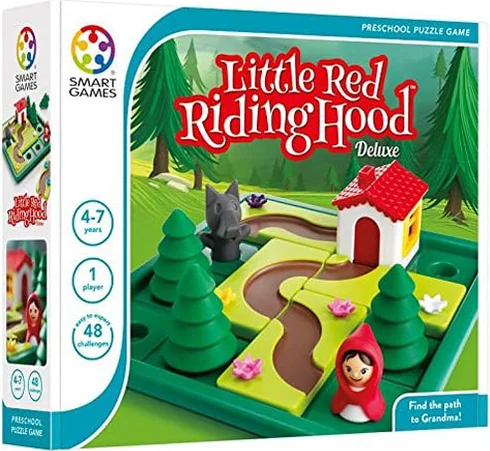
Little Red Riding Hood Deluxe (from age 4, 1 person, flexible playing time) comes from SmartGames, like Camelot Jr., and also calls for spatial reasoning and planning ahead, as well as problem solving. With its picture book for retelling the story, Little Red Riding Hood Deluxe appeals to fans of fairy tales. As with Camelot Jr., the publisher gives an age range of 4 to 7 for it, so it is less intended for children over 7. Katamino Family (from age 3, 1 to 2 people, about 15 minutes) shares spatial reasoning and cognitive flexibility with Camelot Jr. and adds mental rotation. Katamino Family suits children who like laying out and stacking pieces, and allows parent-and-child duels between players of different abilities. Anyone who gives up quickly under time pressure is less well served by Katamino Family.
Sources
Frequently asked questions
What age is Camelot Jr. suitable for?
Camelot Jr. is recommended from age 4; the levels start with Starter from age 4 and end with Master from age 7. A child is ready when they can set up wooden pieces precisely and trace a route with their eyes. According to one customer review, three-year-olds need someone to guide them.
How long does a game take and how many people can play?
The playing time is flexible, because each challenge is solved separately. The game is for 1 child, who plays alone; the solution to each challenge is on its back.
What skills can Camelot Jr. help develop?
The skills profile lists logic and planning. Stairs can stand upright, lie flat or be turned over, including as a flat walkway. Since the figures only move once everything is built, the child works through the route in their head before setting off.
Do all the pieces always have to be used?
No: each challenge shows which pieces are built in, no more and no fewer; the rest are put aside. Some children first have to understand this, as a customer review about a three-year-old girl shows.