How it plays
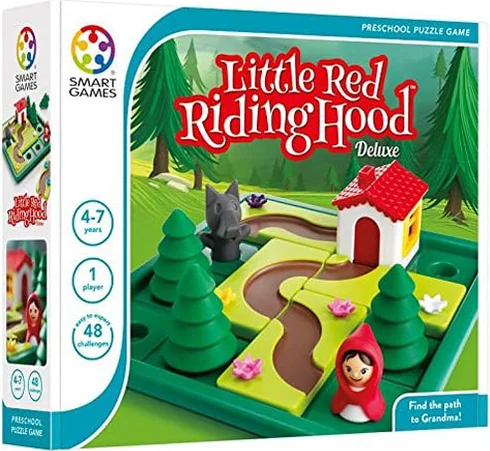
For each challenge (48 in the edition reviewed), the house, three trees and Little Red Riding Hood are placed on the board as shown in the booklet; in half of them, the wolf is added. The child lays path pieces so that a continuous path leads from Little Red Riding Hood to one of the three doors of the house. Easy challenges need one piece, the hardest all five. With the wolf, a second path to a different door is needed; the paths must not cross. Each challenge has exactly one solution.
What it can help develop
Above all, it calls for spatial reasoning: in which position does a path piece connect, and what do the trees and the house block? Planning ahead comes in too: which piece goes next to Little Red Riding Hood, which one in front of the door, and does the piece in between still fit? Younger children try piece by piece; with practice, they recognize in advance what will not fit, and their problem-solving becomes more targeted. With the wolf, two paths have to work out at the same time: what helps one path may take space away from the other.
Especially suitable for
- Children from age 4 who enjoy puzzling things out
- Fairy-tale fans: a picture book for retelling the story
- A quiet solo activity without a screen
Less suitable for
- Children over 7 (publisher: ages 4 to 7)
- Children who prefer to play together
Our verdict
Little Red Riding Hood Deluxe is a worthwhile choice for children from age four who enjoy puzzling things out, and as a quiet activity without a screen. Its strength: the challenges rise through four levels, and a wordless picture book invites children to retell the story. Its limitations are the age window up to about seven, the help that many need at the beginning and the purely solo format.
Getting started
- Help with the setup: line up the house by its chimney, place the trees and figures exactly as shown in the booklet and do not move them afterwards.
- Small flowers under each challenge show which path pieces are needed; leave the rest beside the board.
- Choose challenges without the wolf to start with, because the wolf makes it harder.
In detail
Variants and player count
According to the publisher’s German page, Little Red Riding Hood Deluxe is a game for one person aged 4 to 7, with challenges both without and with the wolf. According to smartgamesandpuzzles.com, the house has three doors and is aligned by its chimney; spaces may be left empty, and pieces that are not needed stay next to the board. The official US shop names four levels: Starter, Junior, Expert and Master.
What reviewers say
According to the SmartGames list of awards, the game, called Little Red Riding Hood there, won the Årets Barnspel in Sweden in 2017 in the best children’s game category. According to Wikipedia, this is an award from the Swedish toy trade. On the official US shop’s page, customer reviews praise the good build quality and the increasing difficulty. As criticism, customer reviews there say that it is frustrating for children who do not like logic puzzles or are too young, and that the wolf section is too hard even for a seven-year-old. The family blog Happy Strong Home highlights the bound picture book without text, whose pictures the blogger’s four-year-old son narrated; according to the blog, it gets harder with the wolf.
How it compares
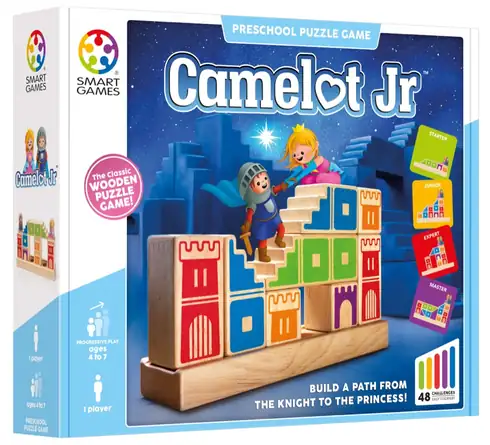
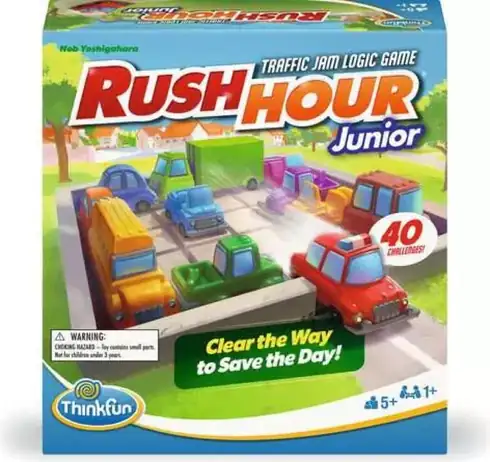
Camelot Jr. (from age 4, 1 person, flexible playing time) is, like Little Red Riding Hood Deluxe, by SmartGames and also calls for spatial reasoning and planning ahead. Rush Hour Jr. (from age 5, 1 person, flexible playing time) by ThinkFun shares logic and planning with Little Red Riding Hood Deluxe and also calls for planning ahead and spatial reasoning. Rush Hour Jr. is suitable as a stepping stone to the full Rush Hour; it is less suited to experienced puzzlers from age 8. Little Red Riding Hood Deluxe also calls for problem-solving and, with its picture book for retelling, appeals to fans of fairy tales; the publisher gives ages 4 to 7, and it is less intended for children over 7.
Sources
- SmartGames: Rotkäppchen Deluxe (publisher’s page, in German)
- smartgamesandpuzzles.com: Little Red Riding Hood
- Smart Toys and Games: Little Red Riding Hood (US shop, customer reviews)
- SmartGames: awards (publisher’s list)
- Wikipedia (German): Årets Spel
- Happy Strong Home: Board Games That Boost Brain Power (family blog)
Frequently asked questions
What age is Little Red Riding Hood Deluxe suitable for?
Little Red Riding Hood Deluxe is recommended from age 4, and the publisher gives ages 4 to 7. Most children need support at the beginning, because even setting up correctly takes some doing. Children who have little interest in logic puzzles are more likely to get frustrated.
How long does a game take and how many people can play?
The playing time is flexible; easy challenges need one path piece, the hardest all five. Little Red Riding Hood Deluxe is a solo game for 1 child, and the challenges in the booklet provide material for many sessions.
What skills can Little Red Riding Hood Deluxe help develop?
Little Red Riding Hood Deluxe can help develop logic and planning. Children have to judge how a path piece, once turned, fits the door or Little Red Riding Hood without the trees or the house getting in the way. Four-year-olds often try out piece after piece, while older children choose more deliberately.
What if the wolf challenges are too difficult?
That happens; according to buyer comments, the wolf part can be too hard even for seven-year-olds. With the wolf, a second path to a different door is needed, without any crossings. Half of the challenges do not involve the wolf at all.