How it plays
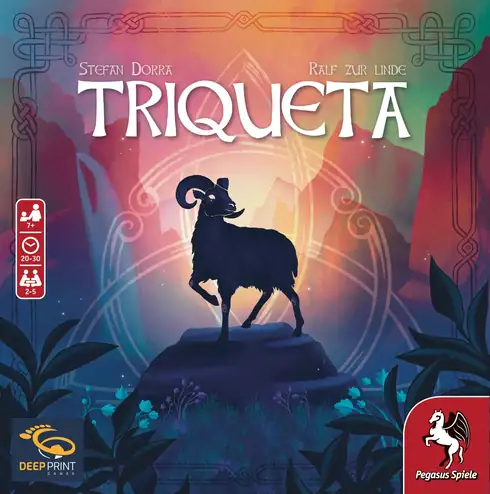
Sixty wooden tiles show six types of animal, worth 5 (rabbit) to 10 (bear). On their turn, a player draws a tile, looks at it secretly and places it face up in an animal row (twice per game, they may keep it face down instead). Alternatively, they take a whole row and drop out of the round. Exactly three identical animals form a triqueta and score the printed value; each tile beyond that devalues it and costs a point. After four rounds, the highest score wins.
What it can help develop
At its core is weighing risks: do I take the row now, or draw another tile and risk someone snapping it up or an animal being added of which I already have three? This calls for impulse control: collecting here means stopping at three, even when the fourth bear is tempting. Planning ahead comes in too: what do the others need? Their visible tiles usually give it away, and so a row can be deliberately spoiled for them.
Especially suitable for
- Children from age 7 who like weighing things up
- Groups of four or five
- Groups spanning generations: children quickly keep up
Less suitable for
- Two-player games with the base game
- Children who cope badly with penalty points and mean moves
Our verdict
Triqueta is a worthwhile choice for families with children from age 7 who like weighing things up and play with four or five people. High-quality components, easy-to-understand rules and decisions with bite carry the game; reviewers see a kinship with Coloretto. Its limitations are that the base game lacks friction with two players, and children have to cope with penalty points and mean moves.
Getting started
- Build the four towers of 15 tiles each, one per round, together before the game; this calls for a steady hand.
- Mention beforehand that collecting many tiles early makes the later rounds harder.
- Tell sensitive children beforehand that making rows unattractive for others is part of the game.
In detail
Variants and player count
The game from Deep Print Games has 60 wooden animal tiles in six types of animal and, according to the rules, is intended for 2 to 5 people from age 7. Each type of animal appears ten times, with values from 5 to 10. The second edition includes the “Hidden Wolves” expansion with 15 shadow animal tiles and its own variant for two people. In French, the expansion is called “Les Loups dans l’Ombre”, and in Italian “Lupi nell’ombra”. The French edition was published by Gigamic and the Italian one by Ghenos Games.
What reviewers say
Reich der Spiele sees the art in choosing the right moment to take a row and praises the attractive, high-quality artwork, the simple rules and the tricky decisions. On jungundaltspielt.de, the Spielecafé der Generationen praises the components, which are easy to handle, the good design and the easy start. According to the review, children learn tactical play and planning ahead and quickly become a match for adults; with two players there is too little conflict, while with four or five it really takes off. Talia Rosen of Opinionated Gamers sees Triqueta as a homage to Coloretto by Michael Schacht, with a similar core mechanism, and praises its decisions and aesthetics. A user review on Ludovox calls it “Un sous-Coloretto”, a lesser Coloretto.
How it compares
Port Royal Big Box (from age 14, 2 to 5 people, about 20 to 50 minutes) shares with Triqueta the skills profile of impulse control as well as logic and planning: every card raises the question of whether to take one more or play it safe. Port Royal Big Box suits teenagers from age 14 who enjoy taking risks, and is less suited to children who cope badly with wasted turns. Can’t Stop (from age 9, 2 to 4 people, about 30 to 40 minutes) also calls for weighing risks and impulse control: stopping in time instead of having another go. Can’t Stop suits mixed groups of grandparents and grandchildren, and less so anyone looking for strategy without any luck of the dice. Triqueta, by contrast, suits children from age 7 who like weighing things up, and groups of four or five.
Sources
- Deep Print Games: Triqueta (publisher’s page, in German)
- Deep Print Games: Triqueta rules (PDF, in German)
- Gigamic: rules (PDF, in French)
- Hidden Wolves: rules sheet (PDF, in German)
- Ludovox: Triqueta – Les Loups dans l’Ombre (in French)
- Ghenos Games: Triqueta (in Italian)
- Ludovox: Triqueta (in French)
- Gigamic: Triqueta (in French)
- Reich der Spiele: review (in German)
- jungundaltspielt.de: review (in German)
- Opinionated Gamers: review
Frequently asked questions
What age is Triqueta suitable for?
The recommended minimum age is 7. Children who like weighing up when to stop and can shrug off penalty points and mean moves are ready. According to one review, children quickly keep up with adults.
How long does a game take and how many people can play?
A game takes about 20 to 30 minutes. The game is for 2 to 5 people, who play against each other over four rounds, and whoever has the most points at the end wins. It works better with four or five people than with two.
What skills can Triqueta help develop?
It can help develop impulse control as well as logic and planning. Players have to be able to stop at three identical animals, even when a fourth is tempting, and the visible tiles of the others reveal which animals they currently need.
Does Triqueta work with two players?
The base game only to a limited extent: it is criticized for lacking friction with two players. Since the second edition, the box has included the “Hidden Wolves” expansion, which brings its own variant for two people.