How it plays
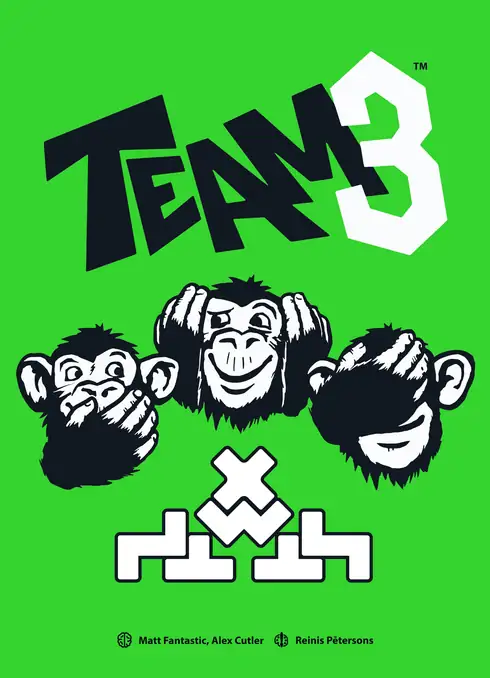
Three roles, one building: the architect is the only one who sees the blueprint card but may only use gestures, neither speaking nor pointing at pieces. The site manager interprets the gestures and directs the builder, who keeps their eyes closed. The builder fits Tetris-like plastic pieces together into an upright building, which has to match the plan from the architect’s point of view. Three minutes per building, then the roles rotate. If the team completes enough buildings before failing too often, everyone wins together.
What it can help develop
TEAM3 calls for communication under difficult conditions. The architect translates the shape, position and rotation of a piece into gestures and considers what the site manager can read from them (perspective-taking). Sticking to the ban on speaking requires impulse control. The site manager describes pieces by shape rather than color, because the builder cannot see anything. The builder feels the pieces and places them as instructed: manual dexterity and spatial reasoning without visual control. When misunderstandings arise under time pressure, frustration tolerance is called for.
Especially suitable for
- Teenagers from age 14 who enjoy building and explaining
- Families who enjoy lively commotion and laughter
- Group sessions that practice working together
Less suitable for
- Shy players who dislike gesturing in front of others
- Players who cannot cope well with time pressure and noisy, hectic play
Our verdict
TEAM3 GREEN is a worthwhile choice for families and groups from age 14 who enjoy puzzling things out together and laughing, and who can cope with a little commotion. The team wins or loses together, and even watching is fun. Its limitation is the time pressure, which does not suit everyone, and the fact that the necessary three-minute timer is not included in the box.
Getting started
- Have the site manager describe the pieces by shape rather than color, because the builder can only feel them.
- With four to six people, let the others watch and pass the roles on after each building. According to one review, watching is almost as entertaining as playing.
- Explain that the blueprint cards come in three difficulty levels and that the game is lost once the number of failed buildings equals the number of people playing.
In detail
Variants and player count
According to the publisher Abacus, the box contains 10 building pieces, 3 role cards, 70 blueprint cards and a card holder, among other things; according to Brain Games, the building pieces are made of plastic. Reich der Spiele describes the building pieces as colored, including pink and yellow, and writes that 5 to 10 of them are needed for each building. According to the rules, the blueprint cards come in three difficulty levels. According to the rules, the game is won with as many buildings as there are people playing, plus the stars of the difficulty level. It is lost as soon as the number of failed buildings equals the number of people playing. According to the rules, a three-minute timer is also needed.
What reviewers say
According to Abacus, the Stuttgart games fair awarded TEAM3 its Lernspielpreis in 2020; the public decided online among the jury’s three favorites. According to the publisher’s announcement, TEAM3 carries the “spiel gut” seal from the “spiel gut” association; the announcement applies to the green and the pink version. Board Game Quest considers the game, with its Tetris-like shapes, very easy to learn; according to the review, watching is almost as entertaining as playing, and there is a lot of laughter. Reich der Spiele says the game divides opinion: players have to enjoy hectic play, time pressure and stress.
How it compares
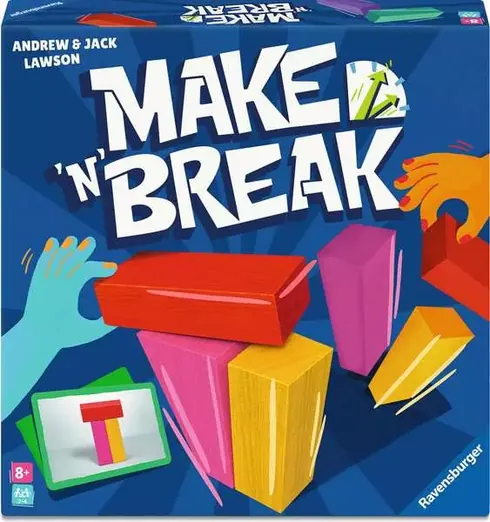
Make ’n’ Break (from age 8, 2 to 4 people, about 30 minutes) covers the skill areas of fine motor skills as well as logic and planning and calls for spatial reasoning. TEAM3 GREEN shares these areas, spatial reasoning and the playing time with Make ’n’ Break. Make ’n’ Break is a race in which processing speed counts; in TEAM3 GREEN, the team wins or loses together. Tangram (from age 8, 1 person, about 10 to 15 minutes) also has fine motor skills as well as logic and planning and calls for spatial reasoning, but is played alone. TEAM3 GREEN suits teenagers from age 14 who enjoy building and explaining, and family groups who like commotion and laughter; it is less suited to shy players who dislike gesturing in front of others.
Sources
- Abacus Spiele: TEAM3 grün (publisher’s page, in German)
- Abacus Spiele: TEAM3 grün rules (PDF, in German)
- Brain Games: TEAM3 Green (publisher’s page)
- Abacus Spiele: announcement on the Lernspielpreis 2020 (in German)
- Abacus Spiele: announcement on the “spiel gut” seal (in German)
- Board Game Quest: review
- Reich der Spiele: review (in German)
Frequently asked questions
What age is TEAM3 GREEN suitable for?
The recommended minimum age is 14. Teenagers are usually ready when they enjoy building or explaining and can cope with lively goings-on. Anyone who finds gesturing in front of others difficult is better off starting with the role that involves no performing, that is, the builder.
How long does a game take and how many people can play?
A game takes about 30 minutes. The game is for 3 to 6 people, who play together as a team: there are three minutes per building, after which the roles change, and the remaining players watch. The team wins or loses together.
What skills can TEAM3 GREEN help develop?
It can help develop cooperation, logic and planning as well as fine motor skills. The architect uses gestures to show how a piece is shaped and positioned, the site manager turns this into instructions, and the builder puts the pieces together with eyes closed.
Do you need to like time pressure?
It helps. A three-minute timer runs for each building, and one review calls the game divisive because it requires enjoyment of a hectic pace and stress. Anyone who prefers to play calmly will find less to enjoy in this pace.