How it plays
In the edition reviewed, the metal tin contains seven wooden pieces (five triangles in three sizes, a square and a parallelogram). It also holds a booklet with over 800 templates: figures, boats and many abstract shapes. Each one shows, as a black silhouette, what is to be made. The silhouette is recreated exactly using all seven pieces, placed next to each other and never on top of one another. The solutions are at the back of the booklet. The instructions of the edition reviewed provide for neither points nor a time limit.
What it can help develop
Tangram calls above all for spatial reasoning: the silhouette gives little away about where the pieces go, so the shape has to be broken down mentally. Does a large triangle fit into this point, and where does the square go then? Pieces are turned and flipped by hand, but their position needs to be thought through beforehand; the parallelogram sometimes only fits once it is flipped over. Geometry emerges along the way: two small triangles make a square. Dead ends are part of it: anyone who starts again instead of giving up practices problem-solving and perseverance.
Especially suitable for
- School-age children who like puzzling things out on their own
- On the go: on the train, on vacation, in the waiting room
- Children who enjoy shapes and patterns
Less suitable for
- Children aged 4 to 6, and children who give up quickly
- Families looking for a competitive game with a winner
Our verdict
Tangram is a worthwhile choice for school-age children who enjoy puzzling quietly and have an eye for shapes and patterns. In the metal tin of the edition reviewed, it is also a travel game. The shape puzzle calls above all for spatial reasoning and patience. The many templates with solutions in the booklet of that edition keep children busy for a long time. Its limitations are the lack of competition and a winner, and the frustration of children who give up quickly.
Getting started
- At first, copy the solution pictures with the pieces drawn in, and only later switch to the black silhouettes.
- Make clear beforehand that all seven pieces are used and lie next to each other, never on top of one another.
- Compare the pieces first: two of the small triangles together fill the area of the square, and the parallelogram is the only piece that sometimes has to be flipped over.
In detail
Variants and player count
The publisher Schmidt Spiele lists the original Tangram (item number 51213) for 1 player from age 8; its shop offers it as a travel game in a metal tin. In that edition, the components are seven wooden pieces (a square, a parallelogram and five triangles, according to Wikipedia two large, one medium and two small) and instructions with many templates. All seven shapes are used, placed next to each other rather than on top of each other, and the template is recreated exactly; the solutions are on the last pages. The instructions of that edition provide for neither points nor a time limit. A children’s edition from Schmidt (item number 51406, from age 5, seven colored wooden pieces) is a different edition.
What reviewers say
No independent review of Tangram is listed. The instructions say that it is not a game in the strict sense; according to the instructions, it comes from China and was at times a real craze in Europe and America. The educational supplier Timetex lists Tangram among teaching materials for elementary school and mathematics and mentions a playful approach to geometric shapes and areas. On the retailer page Toys Boulevard, there are three customer reviews of the metal Tangram from Schmidt (2015, 2017, 2022). One calls it simple, effective, unbreakable and full of possibilities, one finds the wood a little light but the metal tin nice, and one speaks of good quality.
How it compares
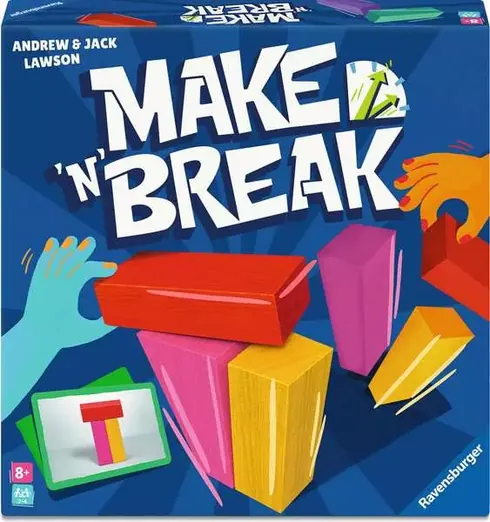
DropZone (from age 8, 1 person, flexible playing time) shares with Tangram the skill areas of fine motor skills as well as logic and planning and, like Tangram, calls for spatial reasoning and problem-solving. Instead of seven shapes, DropZone has track pieces for balls to slot in. Make ’n’ Break (from age 8, 2 to 4 people, about 30 minutes) covers the same two skill areas, plus perception and speed, and, like Tangram, calls for spatial reasoning; in Make ’n’ Break, players build at the same time in a race for points. Tangram suits school-age children who like puzzling things out on their own, and playing on the go. Tangram is less suited to children aged 4 to 6, children who give up quickly and families looking for a competitive game with a winner.
Sources
- Schmidt Spiele: Tangram (publisher’s page, in German)
- Schmidt Spiele shop: Tangram (in German)
- Schmidt Spiele: Tangram instructions (2025)
- Schmidt Spiele: Tangram Kids (publisher’s page, in German)
- Wikipedia: Tangram
- Timetex: Tangram (Lehrmittel Grundschule, in German)
- Toys Boulevard: Metal Tangram, customer reviews (in French)
Frequently asked questions
What age is Tangram suitable for?
Tangram is recommended from age 8. A child who starts again after a dead end instead of giving up is ready; it is less suitable for children aged 4 to 6 and for children who give up quickly.
How long does a game take and how many people can play?
The playing time is about 10 to 15 minutes. Tangram is intended for 1 person (solo); the instructions of the edition reviewed provide for neither points nor a time limit.
What skills can Tangram help develop?
Tangram can help develop fine motor skills as well as logic and planning. From the black outline, the child has to work out how the shape divides into the seven pieces, and the parallelogram sometimes has to be flipped over to do so. The pieces are then laid exactly edge to edge.
What can you do if a child gets stuck?
In the booklet of the edition reviewed, every template has a solution on the last pages. Showing a single piece is often more helpful than the whole solution; that way, the child still does the puzzling.