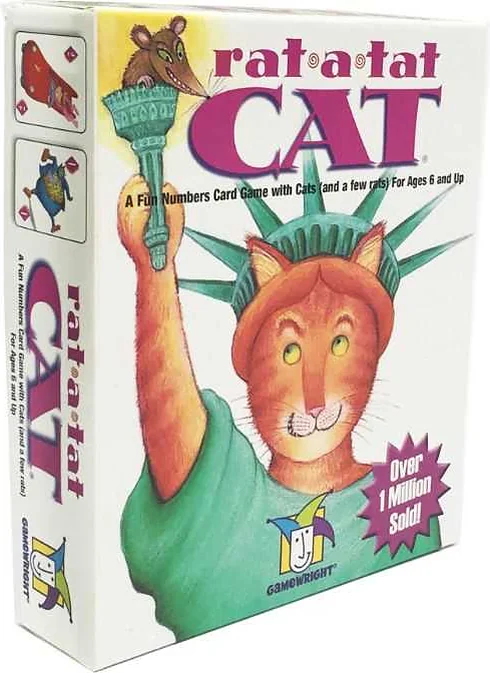
How it plays
Each player lays four cards face down in a row and takes a quick look at only the two outer ones. The values range from 0 to 9. On their turn, players take the face-up card from the discard pile or draw from the deck, and may exchange a number card for one of their own. Power cards allow players to peek, draw twice or swap with another player. Whoever is satisfied knocks on the table and says “rat-a-tat cat”: all the others then have one more turn. After several rounds, the lowest total wins.
What it can help develop
Rat-a-Tat Cat above all calls on working memory, or more precisely on updating it: four positions with two known values at the start, and every swap overwrites a position. If someone uses a Swap card to slip a player a card, what that player knew about this position no longer applies: the new card is probably high. Players who know what they do not know use Peek cards in a targeted way. Every turn calls for comparing numbers; before knocking, players estimate their total and weigh up the risk of unknown cards.
Especially suitable for
- Children from age 6 who know the numbers up to 9
- Mixed groups: adults have hardly any advantage
- Short games for a spare moment, including with two players
Less suitable for
- Children who find bad luck when drawing hard to cope with
- Groups looking for tactics and interaction
Our verdict
Rat-a-Tat Cat is a worthwhile choice for children from age 6 who are confident with numbers up to 9 and for groups of young and old in which adults have no real advantage. The rules are quick to explain, the rounds are short and memory is in strong demand; under this name, it received the Mensa Select award in the USA in 1996. Its limitations are a lot of luck when drawing and little interaction.
Getting started
- Explain knocking early on: whoever is happy with their cards knocks, and then every other player has one more turn.
- Say beforehand that there are as many rounds as there are players (four with two players); the lowest overall total wins.
- With the Swap card, make sure nobody sees the faces of the cards: players swap one of their own face-down cards for one belonging to another player.
In detail
Variants and player count
According to the rules of the German Amigo edition (version 3.1, 2022), that edition includes 66 cards: 45 number cards from 0 to 9 and 21 special cards. Everyone lays four cards face down in a row and looks at the two outer ones; on their turn, players swap a drawn or face-up number card for one of their own or use a special card. Whoever knocks gives everyone else one more turn; the lowest total wins. According to Wikipedia, the game was originally published by Gamewright as Rat-a-Tat Cat; Amigo brought it out in German as “Biberbande” in 2002.
What reviewers say
Hall9000 notes an element of luck and rather little interaction, considers the short playing time suitable for children and sees memory being challenged; a reader’s comment there sees young and old with equal chances. Cliquenabend considers the rules quick to explain, but notes a lot of luck and hardly any interaction; according to Cliquenabend, the game works without problems with two. brettspielblog.ch calls it an entertaining variant of memory (matching pairs) that calls for a good memory plus a little luck. Reviewing the French edition, scifi-universe calls the game quick and suitable for families, but very dependent on chance. According to Wikipedia, Rat-a-Tat Cat received the Mensa Select award in 1996.
How it compares
My First Stone Age (from age 5, 2 to 4 people, about 15 minutes) shares the skill area of memory with Rat-a-Tat Cat, but combines it with logic and planning. My First Stone Age suits children who like collecting and building, and is less suited to children aged 8 to 10 who are looking for more depth. Cabo (from age 8, 2 to 5 people, about 30 minutes) shares the skill areas of memory as well as numbers and arithmetic with Rat-a-Tat Cat and adds impulse control. Cabo suits families who have found Rat-a-Tat Cat too easy; children who cannot yet add up confidently are less well served by Cabo. Rat-a-Tat Cat suits children from age 6 who know the numbers up to 9, and mixed groups in which adults hardly have an advantage; it is less suited to groups looking for tactics and interaction.
Sources
Frequently asked questions
What age is Rat-a-Tat Cat suitable for?
Rat-a-Tat Cat is recommended from age 6. A child is ready when they can compare the numbers from 0 to 9 confidently and remember what is in their four positions. Anyone who finds it hard to shrug off bad luck when drawing will enjoy it less.
How long does a game take and how many people can play?
A game takes about 20 minutes. The game is for 2 to 6 people, who play against each other, and it also works well with two. There are as many rounds as there are players (four with two players), and the lowest total wins.
What skills can Rat-a-Tat Cat help develop?
The skills profile lists memory as well as numbers and arithmetic. Whoever swaps replaces what they remembered at that position, and if a Swap card is used to slip them an unknown card, what they knew about it no longer applies. Before knocking, players estimate their total.
Do adults have an advantage?
Hardly. Reviews describe even children holding their own against adults, and in one personal account the youngest child often wins. What counts is a good memory and a little luck.