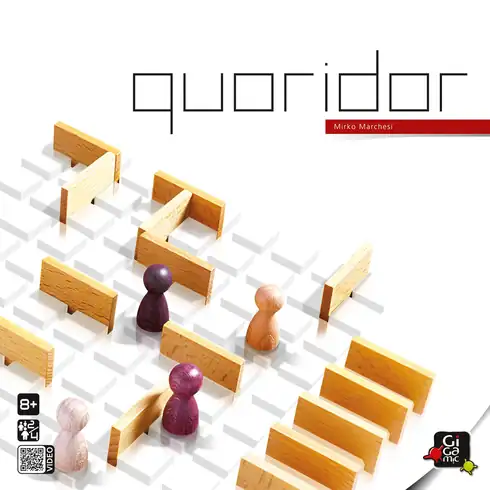
How it plays
On the wooden board of 9 × 9 squares, each pawn starts in the middle of its home row; with two players, each person has ten wooden walls, with four players, five each. On their turn, players either move their pawn one square or place a wall, which spans two squares and stays where it is. Every player must always have a route to their goal left open. A pawn standing directly in front may be jumped over. Whoever reaches the opposite side first wins.
What it can help develop
Every turn asks the same question: move forward or slow the opponent down? To decide, children compare two routes in their head: how many steps do I need, and how many does my opponent need? This calls for planning ahead and spatial reasoning, because a single wall can force a detour of several squares. Every new wall requires players to adjust their plan: cognitive flexibility. And anyone who uses up the scarce walls straight away has nothing left later to slow the others down with, so impulse control is needed too.
Especially suitable for
- Children from age 8 who enjoy brain-teasers
- Parent-and-child duels without any luck of the dice
- An introduction to strategy games with short rules
Less suitable for
- Children who take being blocked personally
- Groups who mostly play with four: the board gets crowded
Our verdict
Quoridor is a worthwhile choice for children from age eight who enjoy brain-teasers and for two-player duels with no element of chance. Its strength: the rules can be explained almost without words, and every turn raises the question of whether to move on or block the opponent’s path. Its limitations are the crowded board with four players and children who quickly feel hurt by being blocked.
Getting started
- Before the first game, make clear that every player must always have a route to their goal and that walls stay where they are placed. Whoever places a wall checks this first.
- Use a short example to show how to jump over a pawn standing directly in front.
- Start with two-player games before moving on to the more crowded board with four.
In detail
Variants and player count
According to Gigamic, the game includes a wooden board, 20 wooden walls and 4 wooden pawns and is intended for 2 to 4 people from age 8. According to the rules, a player who has no walls left must move their pawn. According to the English Wikipedia, the walls are two squares long and cannot be moved once they have been placed. According to the French Wikipedia, the game has no random element and offers complete information.
What reviewers say
According to Gigamic, Quoridor won Mensa Select 1997, the Grand Prix du Jouet 1997 and the Games Magazine Awards 1998. The English Wikipedia confirms Mensa Select 1997 and names the Games Magazine Game of the Year for 1998. According to the publisher’s page, players like the wooden components and the simple rules. Tom Franklin writes on Meeple Mountain that Quoridor can be explained without words and that every turn is a choice between moving the pawn and placing a wall. According to Franklin, a player’s own maze can unexpectedly become part of the opponent’s; with four players, the board quickly gets crowded, and he likes the game less that way.
How it compares
Azul (from age 8, 2 to 4 people, about 30 to 45 minutes) shares the age and the player count as well as logic and planning with Quoridor, but takes longer. Azul is less suited to children who find penalty points hard to cope with. Chess (from age 8, 2 people) also shares the age and the skill area and, like Quoridor, has no luck of the dice. Chess is less suited to groups of more than two people; Quoridor, by contrast, can be played by up to four. Quoridor suits children from age 8 who enjoy puzzling things out, parent-and-child duels with no luck of the dice at all, and a first step into strategy games with short rules. Quoridor is less suited to children who take being held up personally.
Sources
Frequently asked questions
What age is Quoridor suitable for?
Quoridor is recommended from age 8. A child is ready when they can compare two routes in their head: how many steps do they need themselves, and how many does their opponent need? Anyone who quickly feels hurt by a wall in their path will find it harder at first.
How long does a game take and how many people can play?
A game takes 10 to 20 minutes, and the game is for 2 to 4 people, who play against each other. The winner is whoever reaches the opposite side first. There is no element of chance.
What skills can Quoridor help develop?
Quoridor can help develop logic and planning. A single wall can force the opponent into a long detour, so it pays to use the limited walls wisely and to adjust the plan after every new wall.
Does Quoridor also work with four players?
It does, but one review prefers playing with two, because with four the pawns quickly get in each other’s way. With four players, each person has five walls; with two, ten.