How it plays
Usually there are 41 thin wooden sticks with pointed ends; colored markings show their value, from 2 points up to 20 for the mikado stick. Held upright in a bundle on the table and released, they fall into a tangled pile. The active player pulls out one stick after another: lifting it, rolling it away or pressing down on its tip. If a player touches or moves another stick, it is the next person’s turn. A player who has won the mikado stick may use it as a helper stick. The highest points total wins.
What it can help develop
The focus is on fine motor skills: a steady hand and controlled force, because one tremor and things start to wobble. Impulse control is almost as important: staying slow even as the tension rises, and leaving the tempting mikado stick where it is when it is wedged in. Spatial reasoning comes in too: which stick is free, which is on top, which would drag another one along with it? Those watching pay attention to every movement.
Especially suitable for
- Children from age 4 who enjoy careful, fiddly work
- On the go: it needs hardly any space
- Playing with grandparents who remember it from years ago
Less suitable for
- Groups of adults looking for tactics and variety
- Children who get frustrated easily: one wobble ends the turn
Our verdict
Pick-Up Sticks is a worthwhile choice for families with young children from age 4 who want to work calmly with their fingers, and as a light game to take along on the go. Many people know the rules from their own childhood. Its limitations are the lack of strategy, the low replay value for adults, the frustration of a wobble and discussions about what counts as movement.
Getting started
- Before the first turn, show the permitted techniques: a free stick can be lifted, rolled away or freed by pressing down on its tip.
- To start, hold the bundle on the table with your fist and suddenly let go; this creates the tangled pile.
- According to the rules, whoever has won the mikado stick or a mandarin stick may use it as a helper stick; mention this right at the start.
In detail
Variants and player count
According to the Schmidt rules, there are 41 sticks: one mikado stick worth 20 points, five sticks each worth 10 and 5 points and fifteen each worth 3 and 2 points, 170 points in total. According to the rules, players hold the bundle in their fist on the table and suddenly let go. A mikado stick or a 10-point stick (mandarin) already won may be used as a helper, and pressing down on the tip is allowed. Even the slightest movement counts as a mistake; usually 5 rounds are played. According to the publisher, the Schmidt edition (item number 40425) is intended from age 4. According to Wikipedia and Treccani, the game is called “sciangai” in Italian; in Italy, the name “mikado” is also used.
What reviewers say
No independent expert review of Pick-Up Sticks is recorded. Individual user comments on BoardGameGeek call it a game from childhood that is easy to take on trips, and a very simple, traditional game of dexterity. Critical comments complain that it offers almost no strategy and no replay value; they also say that whether a stick has moved is far too subjective, which leads to arguments.
How it compares
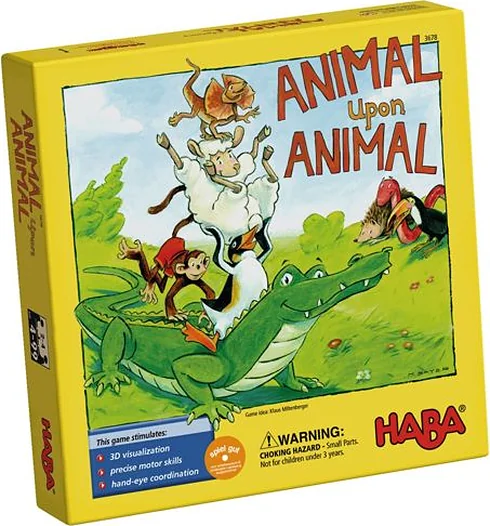
Jenga (from age 6, 1 or more people, about 15 to 20 minutes) shares fine motor skills with Pick-Up Sticks and, like Pick-Up Sticks, calls for impulse control, for example when letting go of a wedged block. Instead of sticks, players build a tower of 54 blocks, and Jenga is less suited to children who are sensitive to noise, because the collapse is loud. Animal Upon Animal (from age 4, 2 to 4 people, about 15 minutes) has the same age and playing time as Pick-Up Sticks (from age 4, 1 to 6 people, about 15 minutes) and shares fine motor skills with Pick-Up Sticks. Instead of impulse control, Animal Upon Animal has logic and planning. Pick-Up Sticks suits children from age 4 who enjoy careful fiddly work, and it is good for taking along on the go; it is less suited to groups of adults looking for tactics and variety.
Sources
Frequently asked questions
What age is Pick-Up Sticks suitable for?
Pick-Up Sticks is recommended from age 4. Children who work carefully with their fingers and can accept that a wobble ends their turn are ready; anyone who gets frustrated quickly is less well served.
How long does a game take and how many people can play?
A game takes about 15 minutes. The game is for 1 to 6 people. When several people play, they take turns playing against each other, usually over several rounds, and the highest points total wins.
What skills can Pick-Up Sticks help develop?
It can help develop fine motor skills and impulse control. For example, every pull calls for a steady hand with controlled force, and a wedged mikado stick is better left where it is, however tempting it may be.
Is Pick-Up Sticks exciting for adults too?
Only to a limited extent: players’ comments say they miss strategy and replay value. As a simple game of dexterity that many people know from childhood and that is easy to take along, it is better suited to family groups and playing on the go.