How it plays
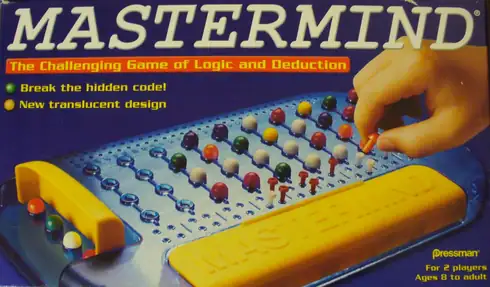
Behind a screen, one person sets a secret code of four pegs in six possible colors. The other guesses row by row. After each attempt, small pegs give the answer: a red or black one for each correct color in the correct position, a white one for each correct color in the wrong position. Which peg is meant remains open. The number of attempts is limited. Then the players swap roles; whoever needs fewer attempts overall wins.
What it can help develop
Mastermind is pure deductive reasoning: every piece of feedback is a condition that the hidden code has to meet. “Row four with yellow and blue got no pegs: both colors are out.” Working memory comes in too: several conditions have to be checked against each other at the same time; the rows stay visible, but the conclusions do not. Skillful guessers change little per attempt and so test one hypothesis after another. Whoever sets the code needs close attention: each peg is scored only once, and a scoring mistake leads the guesser astray.
Especially suitable for
- Children from age 8 who enjoy brain-teasers
- Calm duels between parent and child
- Short thinking games for a spare moment
Less suitable for
- Groups: it is a game for two
- Children who are quickly discouraged by many failed attempts
Our verdict
Mastermind is a worthwhile choice for parents and children from age 8 who want to puzzle things out calmly as a pair. The rules can be explained in minutes, games are short, and children learn to draw conclusions from feedback. In 1973, it received an award from the British toy trade. Its limitations are the scoring pegs, which take getting used to at first, the mechanical codemaker role and monotony among adults.
Getting started
- Make clear that the arrangement of the scoring pegs says nothing about the position of the code pegs; only their number counts.
- When guessing, change only a little in each row so that each attempt tests exactly one assumption.
- If you are setting the code, score especially carefully, because a single mistake sends the guesser down the wrong track.
In detail
Variants and player count
The current Goliath edition is a duel for two with 108 code pegs in six colors and 30 red and 30 white scoring pegs. The German-language Hasbro edition from 2006, by contrast, was a variant for 2 to 5 people with a code lock, eight colors and a score table. According to Wikipedia, the guesser has 8 to 12 attempts. The 2018 Pressman rules give the codemaker one point per row and specifically cover what happens in the event of a scoring mistake.
What reviewers say
In an article for parents on BoardGameGeek, Father Geek recommends Mastermind from age 8. According to the article, the scoring pegs confused the children at first, and scoring correctly is what matters. Another parent’s review on BoardGameGeek says that children aged 9 and 10 enjoy playing it and that it is suitable for introducing them to deduction. Among adults, however, it is too easy, according to this review: once a strategy has been found, it is simply reeled off. In a discussion on BoardGameGeek, the codemaker’s role is criticized as mechanical, while others there defend Mastermind as an educational game for children. A personal account on BoardGameGeek tells of first games as a child, initially without duplicate colors, and of early frustration.
How it compares
Cat Crimes (from age 8, 1 person, flexible playing time), like Mastermind, calls for deductive reasoning and working memory, but it is designed for one person. Cat Crimes suits children who enjoy puzzling things out and read confidently, and it works as a quiet solo activity, including on the go. Cat Crimes is less suitable for beginning readers, because the clues have to be read. Tally Ho! (from age 8, 2 people, about 30 minutes) has the same age and player count as Mastermind (from age 8, 2 people, about 20 to 40 minutes) and shares logic and planning with Mastermind. Unlike Tally Ho!, Mastermind has memory as a second skill area.
Sources
- Goliath: Mastermind (product page, in German)
- Hasbro: Mastermind instructions 44220 (PDF, in German)
- Wikipedia: Mastermind
- BoardGameGeek: Pressman rules 2018 (forum)
- BoardGameGeek: article for parents by Father Geek
- BoardGameGeek: review by a parent
- BoardGameGeek: review and discussion
- BoardGameGeek: personal account
Frequently asked questions
What age is Mastermind suitable for?
Mastermind is recommended from age 8. Children who enjoy brain-teasers, can cope with failed attempts and are not put off by the scoring pegs, which are confusing at first, are ready. Anyone who is easily discouraged will enjoy it less.
How long does a game take and how many people can play?
A game takes about 20 to 40 minutes. The game is for 2 people, who play against each other: one sets the secret code, the other guesses, and then the roles are swapped.
What skills can Mastermind help develop?
It can help develop logic and planning as well as memory. Each piece of feedback narrows down the code, and several have to be kept in mind at once: if a row with two colors received no pegs, both colors are ruled out.
Is Mastermind a game of pure luck?
Hardly: according to a family review, success depends little on luck after the first row. What matters is reading the feedback carefully and choosing attempts so that each one tests one thing.