How it plays
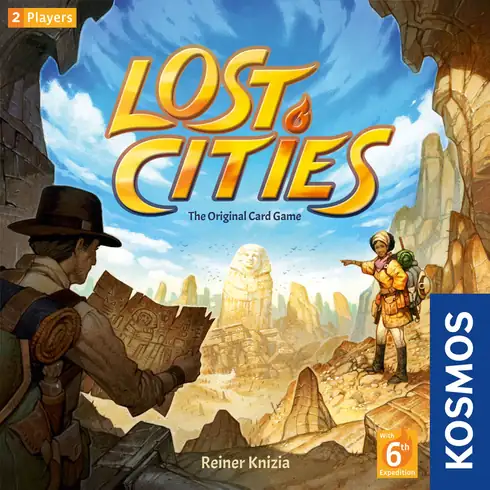
In the base game, two people fit out expeditions in five colors; each color has number cards from 2 to 10 and three wager cards. This edition adds a sixth expedition, which the rules use for a longer variant. On their turn, a player either adds one of their eight cards in hand to their own expedition, always higher than the last one, or discards it onto the discard pile of its color. Then they draw a card: face down from the draw pile or from a discard pile. Every expedition started costs 20 points, and wager cards multiply both profit and loss. A round ends as soon as the draw pile is empty. After three rounds, the higher total wins.
What it can help develop
At its core are weighing risks and planning ahead: is it worth starting an expedition with a 4 and a 6 when it only makes a profit once the cards total more than 20? Wager cards have to be placed before the first number, so players commit themselves before they know what is coming. The tempting 9 calls for impulse control: played too early, it blocks all the lower cards of that color. Working memory (only the top card of each discard pile is visible) and mental math come into play as well.
Especially suitable for
- Parent-and-child duels from about age 10
- Siblings and couples looking for short duels
- Children who enjoy weighing things up, taking risks and calculating
Less suitable for
- Groups of more than two people
- Children who find it hard to cope with bad luck when drawing cards
Our verdict
Lost Cities Card Game with 6th Expedition is a worthwhile choice for two people from age 10, such as a parent and child or couples, who are looking for a short duel with tricky decisions. In 2000, it won the International Gamers Award for the best two-player strategy game. Its limitations are the noticeable luck factor, hardly any direct interaction and the calculation-heavy scoring.
Getting started
- Explain early on that wager cards may only be placed before the first number card of a color.
- Point out that the round ends with the last card of the draw pile; by then, every expedition started should have earned back its cost of 20 points.
- Explain the scoring for each color: the total of the cards minus 20, times 2, 3 or 4 with wager cards, plus 20 for eight or more cards.
In detail
Variants and player count
According to the Kosmos rules (“Lost Cities – Das Duell”), the base game consists of 60 cards in 5 colors: in each color, the values 2 to 10 and 3 wager cards. For each expedition, the total of the card values minus 20 counts. With 1, 2 or 3 wager cards, the result is multiplied by 2, 3 or 4, and from 8 cards upwards there is a bonus of 20 points. A round ends with the last card of the draw pile; whoever is ahead after 3 rounds wins.
What reviewers say
According to Wikipedia, the game won the International Gamers Award in 2000 as the best two-player strategy game; Keltis, Spiel des Jahres 2008, is based on it. On Opinionated Gamers, it comes first in a list of great two-player games. Greg Schloesser writes there that the simple rules are deceptive: there are many difficult decisions, such as when to start an expedition, when to bet and what to discard. In the comments on this review, limited interaction and a somewhat tedious, error-prone final count are mentioned. Meeple Mountain writes that the choice between playing and discarding a card is often a difficult decision with limited information; the scoring seems calculation-heavy at first. Reich der Spiele calls the rules extremely simple, the depth greater than expected and the influence of chance considerable.
How it compares
In the catalog, Lost Cities Card Game with 6th Expedition (from age 10, 2 people, about 30 minutes) is listed under impulse control as well as logic and planning. The Fox in the Forest (from age 10, 2 people, about 30 minutes) and Skull (from age 10, 3 to 6 people, about 15 to 30 minutes) are listed there too. Lost Cities Card Game with 6th Expedition also has numbers and arithmetic, while Skull has cooperation instead. The Fox in the Forest is, like Lost Cities Card Game with 6th Expedition, a game for 2 people. According to the catalog, The Fox in the Forest is a trick-taking game with special cards in which anyone who greedily takes too many tricks ends up with nothing.
Sources
- Kosmos: “Lost Cities – Das Duell” rules (PDF, in German)
- Wikipedia (German): Lost Cities
- Wikipedia (German): Keltis
- Wikipedia: International Gamers Award
- Wikipedia: Lost Cities
- Opinionated Gamers: review by Greg Schloesser
- Opinionated Gamers: list of great two-player games
- Meeple Mountain: review
- Reich der Spiele: review (in German)
Frequently asked questions
What age is Lost Cities Card Game with 6th Expedition suitable for?
Lost Cities Card Game with 6th Expedition is recommended from age 10. A child who likes to weigh things up and take risks, can manage subtraction and multiplication in the scoring and copes when the cards drawn do not fit is ready.
How long does a game take and how many people can play?
A game takes about 30 minutes. The game is designed for exactly 2 people, who play against each other; it is not suitable for larger groups.
What skills can Lost Cities Card Game with 6th Expedition help develop?
It can help develop impulse control, logic and planning as well as numbers and arithmetic. For example, players have to weigh up whether an expedition will earn back its starting cost of 20 points; a high card is often better kept in hand.
How much luck is there in Lost Cities Card Game with 6th Expedition?
Luck plays a part: according to one review, the influence of chance is considerable, but whether to play or discard a card remains a difficult decision with limited information. Anyone who finds it hard to cope with bad luck when drawing cards will be less well served.