How it plays
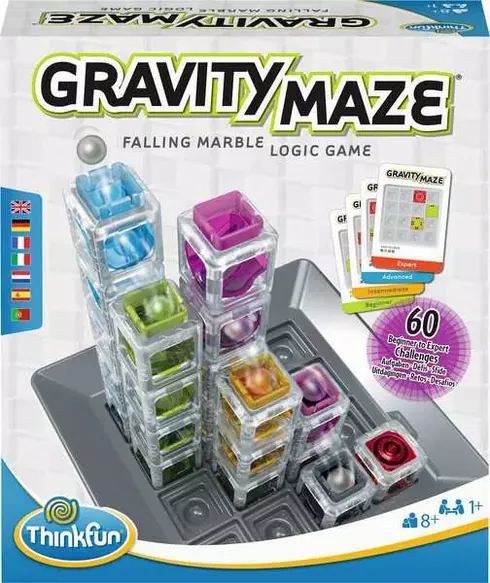
Transparent towers with ramps inside are placed on a grid board: nine colored building towers and one red target tower. Each challenge card (the edition reviewed has 60, spread across four difficulty levels) specifies the starting point, the target tower and, depending on the card, further towers, and shows which towers have to be added. Where they go and which way round is left open. Building rules set limits, such as no more than three towers stacked on top of each other. Then the metal ball is dropped in at the starting point: if it lands in the target tower, the challenge is solved. The solution is on the back.
What it can help develop
Above all, it calls for spatial reasoning. Before placing each tower, the child works out in their head at what height and on which side the ball will leave it and whether the next tower will catch it. Because the cards leave open which way round a tower stands, mental rotation comes in too; working memory has to hold long routes. The ball gives immediate feedback: if it gets stuck or rolls off course, the assumption is rejected and a new one is tested.
Especially suitable for
- Children from age 8 who like puzzling things out and building
- A quiet solo activity on rainy days
- Children who learn by trying things out
Less suitable for
- Game nights together: it is purely a solo puzzle
- Children who give up quickly when things get difficult
Our verdict
Gravity Maze is a worthwhile choice for children from age 8 who enjoy building and trying things out for themselves, and for quiet hours alone. The towers are well made, real physics is more appealing than a screen, and after each tower the ball shows whether the plan is working. Its limitations are its purely solo nature and the tricky later cards, at which children may give up.
Getting started
- Start with the cards from the beginner level and only gradually move on to the higher levels.
- Note that all the towers shown must be used and that no more than three towers may be stacked on top of each other.
In detail
Variants and player count
According to the Ravensburger product page, Gravity Maze is a logic game for one person from age 8; according to the English Wikipedia, ThinkFun has belonged to Ravensburger since 2017. The Ravensburger edition includes challenge cards with solutions in four difficulty levels, a red target tower, nine colored building towers, three balls and a board. According to the official ThinkFun instructions, all the towers specified must be used; the card only specifies whether a tower stands upright or lies flat, not its position and orientation. The building rules include no more than three towers on top of each other, two supports for horizontal towers and a ball that never falls more than one level. The back of each card shows the solution with the path of the ball; some challenges have more than one solution.
What reviewers say
According to the ThinkFun product page, Gravity Maze holds the award “Toy of the Year Winner, Specialty Category” (TOTY 2015). GeekDad (2014) finds the towers well designed; according to the review, they can be fitted into the board and into each other in different orientations. According to the review, real physics is more appealing than physics on an iPad, and the challenges get quite tricky. A GeekDad review from 2017 (Sophie Brown) considers Laser Maze considerably harder than Gravity Maze. According to that review, in Gravity Maze players can add pieces step by step and let the ball run through.
How it compares
Laser Maze (from age 8, 1 person, flexible playing time) calls for spatial reasoning, like Gravity Maze. The profile of Laser Maze also includes logical reasoning and working memory, and in Laser Maze mirrors direct a beam instead of a ball. Both are solo puzzle games and less intended for social groups. Cat Crimes (from age 8, 1 person, flexible playing time) shares the skill area of logic and planning with Gravity Maze. Cat Crimes relies on clues that have to be read and combined, and suits children who enjoy puzzling and read confidently. Gravity Maze, on the other hand, suits puzzle-loving children who like building and learn by trying things out.
Sources
Frequently asked questions
What age is Gravity Maze suitable for?
Gravity Maze is recommended from age 8. A child who likes building, trying things out and carrying on after a failed attempt is ready. Anyone who gives up quickly when things get difficult needs support; the solution is on the back of the card.
How long does the game take and how many people can play?
Gravity Maze is a game for 1 person, and the playing time is flexible: each challenge card is solved separately, and the cards are spread across four difficulty levels. It is not intended for game nights with others.
What skills can Gravity Maze help develop?
The focus is on logic and planning, especially spatial reasoning. After each tower, players think about where the ball will roll and whether the next tower will catch it; because the towers can be turned any way, they also rotate them in their head.
What if a challenge is too hard?
Before looking up the solution on the back of the card, it helps to let the ball run through after each tower is added. This shows step by step where the route breaks off.