How it plays
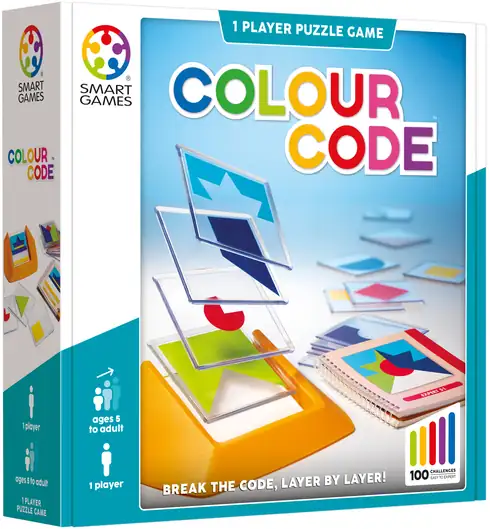
In the edition reviewed, each of the 100 challenges in the booklet shows a picture made of colored shapes. The visible colors reveal which of the 18 transparent tiles, each bearing one shape, could be used. Players rotate or flip them as needed and stack them one after the other on the stand. Upper shapes partly cover lower ones, so the order matters. The challenge is solved when the stack matches the picture exactly. There are four levels, with the solutions in the booklet.
What it can help develop
Color Code calls above all for spatial reasoning. First, look closely: which shapes are in the picture, and which are only partly visible? The trickiest part is the order: whoever recognizes which shape covers another can work out logically what lies underneath and what lies on top. Mental rotation comes in too: every tile is rotated or flipped, often in the player’s head before the hand reaches for it. Anyone who works this way instead of trying things at random makes fewer failed attempts at the higher levels.
Especially suitable for
- Children from age 5 who enjoy shapes and colors
- Children who like to concentrate on puzzling things out alone
- Older children and adults at the highest levels
Less suitable for
- Shared game nights: it is purely a solo game
- Easily discouraged children facing difficult challenges on their own
Our verdict
Color Code is a worthwhile choice for children from age 5 who like shapes and colors and for anyone who enjoys puzzling quietly on their own. According to one review, the components are robust, the task is quickly understood and the levels challenge players all the way up to adults. Its limitations are its purely solo nature and difficult challenges that leave easily discouraged children on their own. The same review also expects children to look at the solutions often.
Getting started
- Start with the easiest of the four levels and only move on once your child succeeds reliably.
- First, pay attention to the visible colors: they show which of the 18 tiles could be used at all.
In detail
Variants and player count
SmartGames lists Color Code for 1 person from age 5. The game includes 18 transparent tiles, each with one colored shape, a stand and a challenge booklet with challenges in four difficulty levels, together with solutions. Color, shape and order must be right, and tiles are flipped over if necessary; a challenge is solved when the arrangement matches the challenge exactly. According to the French publisher’s page, the colors in the picture help in choosing the tiles, after which the orientation and the order have to be found. Major Fun names four levels (starter, junior, expert, master) and four possible orientations for each tile.
What reviewers say
The review by Major Fun says the order is often the hardest part, and calls the game robust and easy to understand, inviting for five-year-olds and challenging for adults. According to the review, children would probably often look at the solutions; the puzzling is sometimes agonizing, but often surprisingly rewarding. The “spiel gut” association awarded Color Code the “spiel gut” seal in 2017. According to the publisher, the game won the Toy of the Year Award in Belgium in 2009, but no independent confirmation of this is on record.
How it compares
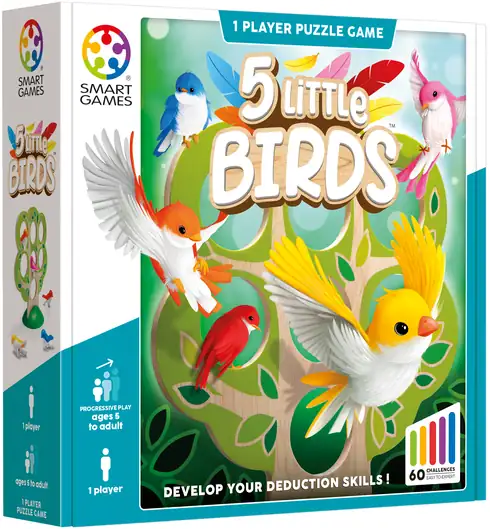
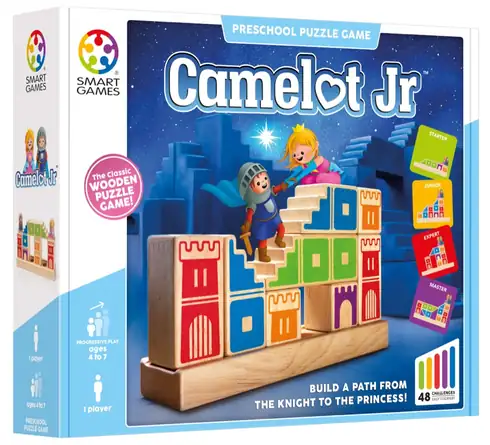
The game 5 Little Birds (from age 5, 1 person, flexible playing time) has the same skill area, logic and planning, and, like Color Code, calls for spatial reasoning. In 5 Little Birds, birds are clipped onto a tree according to a pattern, and deductive reasoning is at the center. Camelot Jr. (from age 4, 1 person, flexible playing time) also has the skill area of logic and planning and, like Color Code, calls for spatial reasoning. In Camelot Jr., players build a path for figures that may only set off once everything is in place. Color Code suits children from age 5 who enjoy shapes and colors and like to concentrate on puzzling things out alone, and, at the highest levels, older children and adults. It is less suitable for shared game nights and for easily discouraged children facing difficult challenges alone.
Sources
Frequently asked questions
What age is Color Code suitable for?
Color Code is recommended from age 5, and according to one review, even five-year-olds can get into it. A child who likes shapes and colors and does not give up straight away is ready. Children who are easily discouraged need someone by their side for the more difficult challenges.
How long does the game take and how many people can play?
Color Code is purely a solo game for 1 person, and the playing time is flexible: the challenges, spread over four difficulty levels, can be solved one at a time. It is not suitable for game nights with others.
What skills can Color Code help develop?
The focus is on logic and planning, especially spatial reasoning. The visible colors show which tiles could be used, the order follows from the question of which shape lies on top of which, and pieces are often rotated in the player’s head first.
Are children allowed to look at the solutions?
The solutions are in the challenge booklet, and one review expects children to look at them often. It describes the puzzling as sometimes a torment, often a joy.