How it plays
On a hexagonal board with 61 spaces, 14 black and 14 white marbles face each other. On each turn, a player moves one, two or three of their own marbles that lie in a line, shifting them by one space, either along the line or sideways. Opposing marbles can only be pushed along the line and only with superior numbers: two against one, three against one or two. The first player to push six opposing marbles off the board wins.
What it can help develop
There is no chance in Abalone: games are won by thinking ahead. Where can I push, and how will my opponent respond? Spotting numerical advantages and free spaces on the hexagonal board calls on visuospatial processing. The edge is instructive: anyone who wants to push an opposing marble off has to go there themselves, and is then at risk. Holding back the first reflex to push a marble off straight away, and first thinking through the opponent’s response, calls for impulse control.
Especially suitable for
- Children from age 7 who enjoy brain-teasers
- Siblings or friends of similar playing strength
- Children who still find chess too complicated
Less suitable for
- Anyone looking for luck, stories or surprises
- Unevenly matched opponents: with no chance involved, the more experienced player usually wins
Our verdict
Abalone is a worthwhile choice for children from age 7 who enjoy puzzling things out and for two opponents of similar ability who are looking for a strategy game without chance. According to the jury of the Spiel des Jahres, its appeal lasts a long time; in 1989 it was on the jury’s selection list. Its limitations are that anyone who likes surprises and luck will hardly warm to it, unevenly matched opponents make it one-sided and games between experienced players can stall.
Getting started
- Show the types of move first: up to three marbles in a row move forward one space together, straight ahead or sideways.
- Practice pushing separately: opposing marbles only give way along the line, and only if your own row is longer than the opponent’s.
- If the game stalls because both players only defend, try a different starting position, such as the “Belgian Daisy”.
In detail
Variants and player count
According to the publisher, the current edition from Zygomatic Games is intended for 2 people from age 7 and contains 14 black and 14 white marbles on a hexagonal board. According to Wikipedia, the board has 61 spaces, and pushing with superior numbers (2:1, 3:1, 3:2) is called sumito. The English Wikipedia names the Belgian Daisy as an alternative starting position; tournaments have been held since 1999. According to the French Wikipedia, there is no element of chance, and beginners have the reflex of pushing out straight away.
What reviewers say
According to Wikipedia, Abalone was on the selection list for the Spiel des Jahres in 1989, a list that existed from 1979 to 2003. According to the French Wikipedia, it received the Super As d’Or in Cannes in 1989 and, in 1998, the As d’Or as game of the decade. According to the English Wikipedia, Abalone was among the first five Mensa Select winners in 1990. The Spiel des Jahres jury describes glass marbles and the utmost caution needed with every action; according to the jury, pushing out leads to the dangerous edge, and the appeal is lasting. According to the English Wikipedia, Games International wrote in 1990 that the game stalls between experienced players and that stalemates are common.
How it compares
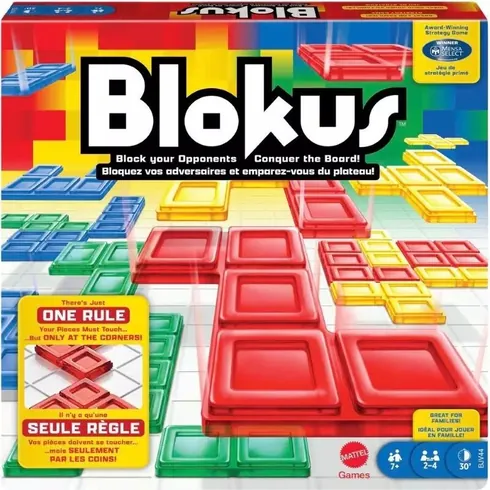
Blokus (from age 7, 2 to 4 people, 20 to 30 minutes) shares the age, the skill area of logic and planning, spatial reasoning and planning ahead with Abalone. Blokus can be played by up to four, while Abalone is purely a two-player game; children who take being blocked personally are less well served by Blokus. Pentago (from age 8, 2 people, about 10 to 15 minutes) is, like Abalone, a two-player game that calls for planning ahead; Pentago adds mental rotation and cognitive flexibility. Abalone suits children from age 7 who enjoy puzzling things out, siblings or friends of similar playing strength, and children who still find chess too complicated; anyone looking for luck, stories or surprises is less well served by it.
Sources
Frequently asked questions
What age is Abalone suitable for?
Abalone is recommended from age 7. A child is ready when they consider how the opponent might respond before pushing, and can take a defeat in their stride when there is no luck to blame. It is a way in for children who are not yet ready for chess.
How long does a game take and how many people can play?
A game takes about 30 minutes. The game is for 2 people, who play against each other, and the winner is whoever is first to push six opposing marbles off the board.
What skills can Abalone help develop?
The skills profile lists logic and planning. To push an opponent’s marble off, players have to move to the edge themselves, where they become vulnerable. So it is important to think through the opponent’s possible reaction in advance.
What if a child keeps losing?
With no chance involved, the more experienced player usually wins when opponents are unevenly matched. Siblings or friends of similar ability are a better fit, so that both sides stand a real chance.