How it plays
Everyone has the same set of cards from 1 to 15 and plays each card only once. In each round, a point card is laid out: a meerkat (a mouse in older editions) worth +1 to +10 or a vulture worth −1 to −5. Everyone lays a card face down and all reveal them at the same time. The highest card gets the meerkat, the lowest the vulture. Equal values cancel each other out. After 15 rounds, the highest point total wins.
What it can help develop
With identical cards, everything depends on reading the others: if several players put their 15 on the ten-point meerkat, they cancel each other out, so would the 14 be better? The others may be thinking the same: perspective-taking at high speed. Weighing risks also plays a part: anyone who uses up high cards early no longer has them later. The first impulse, to play the highest card on a high meerkat, is usually everyone else’s too; holding it back calls for impulse control. Anyone who keeps track of the values played also needs working memory.
Especially suitable for
- School-age children from age 8 who like to bluff
- Mixed groups: everyone starts on an equal footing
- Short games for a spare moment, including on vacation
Less suitable for
- Children who find it hard to cope when plans fall through
- Games with just two players: it thrives with more people
Our verdict
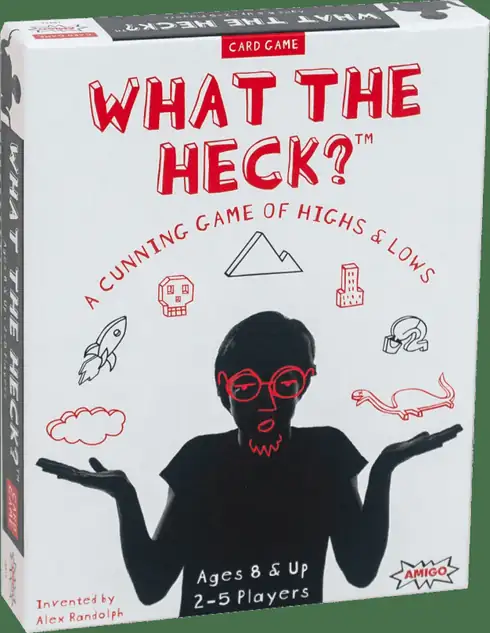
What the Heck? is a worthwhile choice for families with school-age children from age 8 who enjoy bluffing, and for mixed groups of three or more. Everyone has the same cards, the rules are very simple and the simultaneous reveal creates suspense. In 1988, the game was on the Spiel des Jahres selection list. Its limitations are the high luck factor, especially in the first round, and the fact that it works less well with two players.
Getting started
- First use an example to show the rule that equal values cancel each other out: if two people play the same card, neither of them counts.
- Stress beforehand that each card is played only once. High cards that are played early are missing in later rounds.
- Bear in mind that in older editions the point cards show mice instead of meerkats; the rules and the flow of play stay the same.
In detail
Variants and player count
According to the German Wikipedia, the first edition was published by Ravensburger in 1988 with ten mouse cards from +1 to +10 and five vulture cards from −1 to −5. The new edition from Amigo (2018) shows meerkats instead of mice. According to the publisher, the Amigo edition includes 75 number cards and 15 point cards. On the number of players, brettspiele-magazin.de says that the game is best from three players, ideally with the full number; brettspielbox.de recommends at least four.
What reviewers say
The first edition from Ravensburger was on the selection list for the Spiel des Jahres in 1988. In 1996, the game took 10th place in the ranking of the best-placed card games in the À la carte card game award (Fairplay). Brettspielbox.de (on the 2018 Amigo edition) calls the rules very simple and the game fast-paced; in its view, the appeal lies in bluffing and in judging the others. According to brettspielbox.de, keeping track of the other players’ cards helps, but there is a lot of chance, which did not go down well with everyone. The review on brettspiele-magazin.de calls the game quick to explain and says that luck plays a considerable part in the first round. Reich der Spiele (on the 2011 Amigo edition) calls the joint reveal the most exciting moment and recommends warming up with one round first.
How it compares
What the Heck? and The Mind (from age 8, 2 to 4 people, about 15 minutes) share the age, the playing time and the skill area of impulse control. The profile of The Mind also includes cooperation, and the profile of What the Heck? includes logic and planning. No Thanks! (from age 8, 3 to 7 people, about 20 minutes) shares the skill areas of impulse control as well as logic and planning with What the Heck? and adds numbers and arithmetic. No Thanks! needs at least three people but in return works for family groups of up to seven; children who get annoyed when cards are snatched away are less well served there. What the Heck? suits school-age children who like to bluff and mixed groups in which everyone starts on an equal footing; it works less well with two players.
Sources
Frequently asked questions
What age is What the Heck? suitable for?
The game is recommended from age 8. A child is ready when they enjoy bluffing and can cope with a plan falling through. Some memory skills help, because anyone who keeps track of the cards played plays better.
How long does a game take and how many people can play?
A game takes about 15 minutes, and after 15 rounds the highest point total wins. The game is for 2 to 5 people, who play against each other. Reviews recommend at least three to four people, because the game thrives on more players.
What skills can What the Heck? help develop?
It can train impulse control as well as logic and planning. Playing the highest card on a high meerkat is the first thought of almost everyone; anyone who holds back and considers what the others will do plays better. Using up high cards early backfires later.
Does it all come down to luck?
The luck factor is considered high, especially in the opening round; according to one review, the game did not go down well with everyone. Over time, it helps to keep track of the cards played. One review advises warming up with one round first.