How it plays
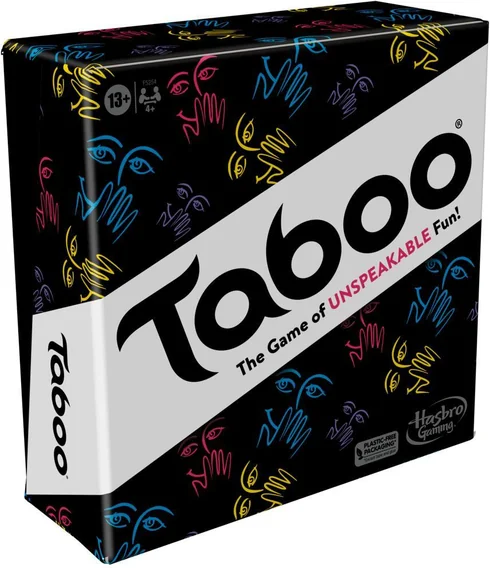
Two teams sit in a circle, alternating seats. Whoever is explaining turns over the top card: the word to be guessed is at the top, with five taboo words below it. Parts of words, gestures and sounds are also forbidden. The explainer’s team tries to guess as many words as possible before the sand timer runs out. An opponent behind the person explaining presses the buzzer whenever a rule is broken. Each word guessed earns the explainer’s team a point; for each card that is buzzed or skipped, the other team gets one. Once everyone has explained the same number of times, the team with the most points wins.
What it can help develop
If the word is “beach”, for example, and “sea” and “sand” are forbidden, the very words that come to mind first are blocked. Whoever is explaining has to suppress these words (inhibition) and find other routes under time pressure: a broader category, an opposite, an everyday scene. This calls for word retrieval and cognitive flexibility, while working memory keeps the forbidden words in mind. The player checking compares every word they hear with the list, which requires focused listening.
Especially suitable for
- Articulate teenagers from age 13 and adults
- Family gatherings and parties with four or more people
- Groups who enjoy talking and guessing fast
Less suitable for
- Shy people who dislike being the center of attention
- Groups with very different vocabularies or language levels
Our verdict
Taboo is a worthwhile choice for articulate teenagers from age 13 as well as for adults at family gatherings and parties with at least four people. The jury considers it genuine party fun that works in very different groups, and it requires players to suppress obvious words. Its limitations are shyness about being the center of attention, very different language levels and a flow of play that some find rather monotonous compared with new party games.
Getting started
- Let newcomers to the game handle the buzzer first, so that they get to know the rules by reading along.
- Divide teenagers and adults between both teams so that differences in vocabulary even out.
- For a more relaxed game, agree on a house rule: one card per round may be set aside without the other team getting a point for it.
In detail
Variants and player count
The details depend on the edition: the Spiel des Jahres jury gives 4 to 12 people for the MB edition. The French and Italian versions of the 2013 Hasbro rulebook give four or more people from age 13. The scoring also differs: according to Wikipedia, an older version of the rules deducted a point for a taboo word. In the 2013 rulebook, by contrast, the other team gets a point for each card that is buzzed or skipped. With the wild card from our tip for parents, one card per round may be set aside without the other team getting a point for it. In addition to parts of words, gestures and sounds, this rulebook also forbids rhyming clues and abbreviations.
What reviewers say
In a review from 2005, Reich der Spiele describes the exuberant party atmosphere in the group. Readers’ comments on Hall9000 call Taboo still a reliable source of fun and a classic. Other comments there find newer party games better and more varied. Taboo received the Mensa Select award from American Mensa in 1990, together with Abalone, Scattergories, Tribond and Trivial Pursuit Genus Edition.
How it compares
Concept (from age 10, 4 to 12 people, about 40 minutes) shares the skill areas of language and flexibility with Taboo; Concept also covers cooperation, and Taboo impulse control. Codenames (from age 10, 4 to 8 people, about 15 minutes) is shorter and appeals to word lovers who enjoy discussing things as a team. Like Taboo, Codenames is less suited to groups with very different vocabularies. Taboo itself suits teenagers from age 13, adults and family gatherings.
Sources
Frequently asked questions
What age is Taboo suitable for?
Taboo is recommended from age 13. Teenagers who like to talk briskly and keep explaining when the obvious word is forbidden are ready. Anyone who dislikes being the center of attention or is still unsure of their language skills finds it harder.
How long does a game take and how many people can play?
A game takes about 45 minutes. The game is for 4 or more people, who play against each other in two teams, and the team with the most points wins once everyone has explained the same number of times.
What skills can Taboo help develop?
Taboo can help develop language, impulse control and flexibility. If, for example, “sand” is forbidden for “beach”, the player has to switch to a broader category, an opposite or an everyday scene while keeping the forbidden words in mind.
What counts as breaking the rules?
The five taboo words are forbidden, as are parts of words, gestures and sounds. A checker from the other team stands behind the person explaining and presses the buzzer if a mistake is made. The other team then gets a point.