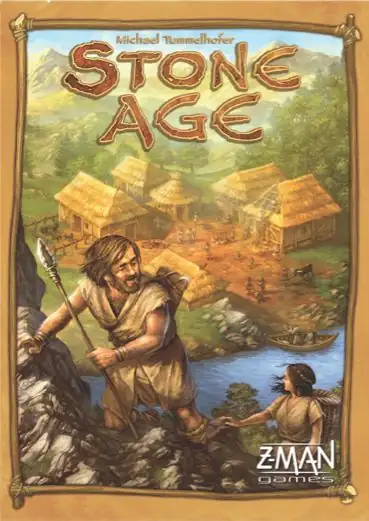
How it plays
Each tribe starts with five figures and twelve food. Taking turns, everyone places figures on locations: the hunting grounds, forest, clay pit, quarry, river, village (tools, field, offspring), buildings or civilization cards. Then, for hunting and resources, players roll one die per figure and divide the total by the value (food 2, wood 3, clay 4, stone 5, gold 6). Resources pay for buildings (points) and civilization cards (an immediate advantage, final scoring). Anyone who does not feed their people loses 10 points. Whoever has the most points wins.
What it can help develop
Stone Age calls for planning ahead and doing without quick returns: tools, fields and offspring tie up figures today and only pay off later. Every roll calls for mental math: pips plus tools, divided by two to six. Two figures to the river even though a weak roll will bring no gold? That is weighing risks. Along the way, working memory keeps track of food requirements and costs; anyone who can guess what the others need can block spaces deliberately.
Especially suitable for
- Children from age 10 who enjoy calculating and puzzling things out
- Families getting into worker placement games
- Mixed groups: the dice narrow the gap in experience a little
Less suitable for
- Younger children: for them there is My First Stone Age
- Children who find bad luck with the dice hard to bear
Our verdict
Stone Age, nominated for the Spiel des Jahres in 2008, is a worthwhile choice for families whose children from age 10 enjoy calculating and are looking for a first worker placement game. It is quick to learn, allows different winning strategies and calls for planning ahead. Its limitation is the higher luck factor of the dice, which can annoy children who are unlucky; younger children are better served by My First Stone Age.
Getting started
- Show the locations at the start: the hunting grounds take any number of figures, the forest, clay pit, quarry and river seven each.
- Work out one yield together: total pips plus tools, divided by 2 (food) to 6 (gold).
- Clarify beforehand how the game ends: when the building pile is empty or when the civilization cards can no longer be refilled.
In detail
Variants and player count
According to the publisher Hans im Glück, its German edition includes 68 wooden resources, and the new edition has revised rules. According to the rules, one die is rolled per figure; the total pips plus tools is divided by 2 (food), 3 (wood), 4 (clay), 5 (stone) or 6 (gold). Each figure must be fed 1 food; missing food is replaced by resources, otherwise 10 points are lost. The game ends when the building pile is empty or when the civilization cards can no longer be refilled; the final scoring follows.
What reviewers say
According to Wikipedia, Stone Age was nominated for the Spiel des Jahres 2008 (won by “Keltis”) and took second place in the Deutscher Spiele Preis 2008 behind Agricola. At the Österreichischer Spielepreis (Austrian games award) 2008, it was named “Spiele Hit mit Freunden”, also according to Wikipedia. The Spiel des Jahres jury database notes that dice decide the yields of building materials and that hunger brings a points deduction, and describes the game as especially for tacticians. According to Wikipedia, Spielbox 2/2008 praised the components with resource pieces in different shapes. Brettspiele-Report calls it quick to learn yet exciting; according to the review, the luck factor is higher because resource yields are determined only by dice, and it is not a game for hard-core strategists. Meeple Mountain finds it easy to explain and sees several paths to victory.
How it compares
In the catalog, Stone Age (from age 10, 2 to 4 people, about 60 to 90 minutes) belongs to the area of logic and planning. So do Carpe Diem (from age 10, 2 to 4 people, about 45 to 75 minutes) and Istanbul (from age 10, 2 to 5 people, about 40 to 60 minutes). Stone Age also has the area of numbers and arithmetic and has the longest games of the three. According to the catalog, Carpe Diem is a compact optimization game and Istanbul a quickly accessible optimization game with many paths.
Sources
- Hans im Glück: Stone Age (publisher’s page, in German)
- Hans im Glück: Stone Age rules (PDF, in German)
- Spiel des Jahres: Stone Age (jury, in German)
- Wikipedia: Spiel des Jahres
- Wikipedia: Deutscher Spiele Preis
- Wikipedia (German): Österreichischer Spielepreis – Preisträgerliste
- Wikipedia (German): Stone Age
- Brettspiele-Report: review (in German)
- Meeple Mountain: review
Frequently asked questions
What age is Stone Age suitable for?
Stone Age is recommended from age 10. A child who enjoys dividing dice totals and thinks several moves ahead is ready; one review also calls it easy to explain to children aged 8 and 11. Younger children can turn to My First Stone Age.
How long does a game take and how many people can play?
A game takes about 60 to 90 minutes. The game is for 2 to 4 people, who play against each other, and the highest score decides.
What skills can Stone Age help develop?
Stone Age can help develop logic and planning as well as numbers and arithmetic. Tools, fields and offspring only pay off in later rounds, and every dice yield requires adding pips and tools and dividing by the value of the resource.
What if a child has bad luck with the dice?
The dice decide the resource yields, which reviews mention as a point of criticism. On the other hand, there are several ways to reach the goal, and in mixed groups the dice even out differences in experience a little.