How it plays
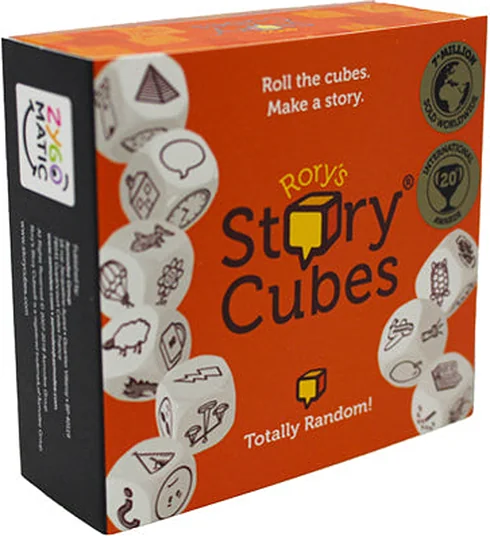
Nine dice, each side showing a picture symbol, such as a key, a castle tower or a tortoise: 54 images in all; in the German edition reviewed, they come in a metal tin. Whoever is telling the story rolls all nine, begins with “Once upon a time…” and links all the pictures into one story, three each for the beginning, middle and end. The only rule: no answer is wrong. There are no points or winners. In one variant, everyone takes turns to tell a chapter of the same story.
What it can help develop
Above all, storytelling skills are called for: nine random pictures have to be put in order and linked with words such as “because”, “suddenly” or “so”, which requires planning and a coherent thread. Word retrieval comes in too: each picture needs a suitable word. Imagination and cognitive flexibility are needed, because pictures can fit literally or figuratively: the magnet attracts iron, or friends. Working memory keeps track of the plot and the dice already used. Without any scoring, hesitant children also find it easier to get started.
Especially suitable for
- Can help build language skills from age 6 and works in any language
- Trips and waiting rooms: the set is compact
- Reserved children who are feeling their way into storytelling
Less suitable for
- Children who need points and clear winners
- Groups looking for tactics and competition
Our verdict
Rory’s Story Cubes Classic is a worthwhile choice for children from age 6 who are cautiously starting to tell stories, and for families who want to practice language on the go or in the waiting room. With nine picture dice and the one rule that no answer is wrong, getting started is easy. Its limitations are the lack of competition, with no points or winners, and the desire for new challenges among those who tell a lot of stories.
Getting started
- Start with “Once upon a time…” and divide the nine dice into three groups of three for the beginning, middle and end.
- For variety, use the “Epic Stories” variant: players take turns to tell a chapter each, and the last player ties up the loose ends.
- The game works in any language, so the language of the story can be chosen freely.
In detail
Variants and player count
As for group size, the publisher Zygomatic gives only a lower limit, “1+”, while BoardGameGeek gives 1 to 12 players. So Rory’s Story Cubes Classic can also be played alone. Figures for the playing time differ: Zygomatic gives 10 minutes, BoardGameGeek 20. According to the publisher’s symbol guide, the 54 symbols include arrows, feelings, the letter “L” and a sinister shadow. Rory’s Story Cubes was first published in 2005. Its publishers have included The Creativity Hub, Gamewright, HUCH! and Zygomatic, which publishes the current edition.
What reviewers say
Michael Weber wrote at Reich der Spiele in 2011 that Rory’s Story Cubes is not a game but a tool for stimulating the imagination. According to the review, it also works with non-gamers and requires a talent for communication and association. In the same year, Sandra Lemberger at Hall9000 praised the fact that it gets children talking and that the small box of the edition reviewed fits in any bag, for example for waiting times in a restaurant or at the doctor’s. She rated the interaction at 2 out of 6. In 2014, Simon Kriese at spieletest.at called it a great introduction to storytelling games. He saw its biggest drawback in the fact that enthusiasts sooner or later look for other challenges.
How it compares
Once Upon a Time: The Storytelling Card Game (from age 8, 2 to 6 people, about 30 minutes) also calls for storytelling with a coherent thread. It suits fairy-tale fans who love telling stories and, like Rory’s Story Cubes Classic, can help develop language and flexibility, plus planning and listening. Once Upon a Time: The Storytelling Card Game is less suited to children who do not like speaking in front of others or telling stories freely. Bananagrams (from age 7, 1 to 8 people, about 15 minutes) shares the skill areas of language and flexibility with Rory’s Story Cubes Classic and also covers perception and speed. Rory’s Story Cubes Classic is more likely to be the choice for six-year-olds and for reserved children who are feeling their way into storytelling.
Sources
Frequently asked questions
What age is Rory’s Story Cubes Classic suitable for?
Rory’s Story Cubes Classic is recommended from age 6. A child who enjoys interpreting pictures freely is ready; reading is not necessary. Anyone who needs clear winners and points will be less happy with storytelling without scoring.
How long does a game take and how many people can play?
A round takes about 10 minutes. The game is for 1 to 12 people, but there is no scoring and no list of winners: players take turns to tell a story, or in one variant each person contributes a chapter.
What skills can Rory’s Story Cubes Classic help develop?
Rory’s Story Cubes Classic can help develop language and flexibility. Nine random pictures have to be put in order to form a story with a coherent thread. Each symbol can be interpreted literally or figuratively, such as the magnet standing for iron or for the attraction between friends.
What if a child does not want to tell a story?
There are no wrong answers and no scoring, which makes it easier for reserved children to get started. At first, three dice laid out in a row beforehand are enough; later, increase to nine.