How it plays
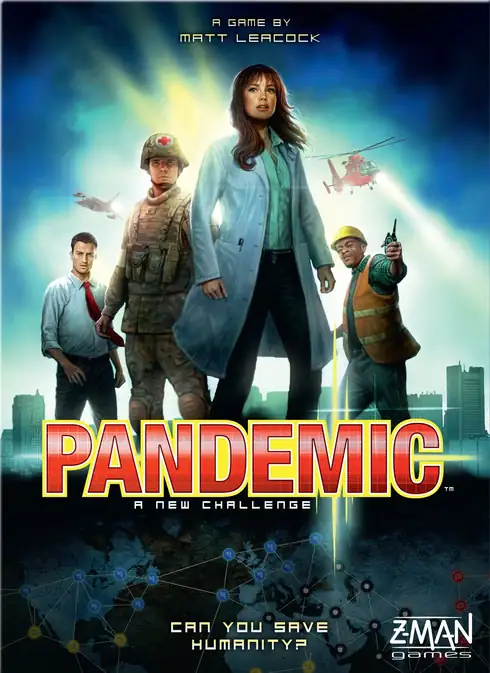
On a map of the world, four diseases spread as colored cubes; each player has a special role. On their turn, players have four actions, such as traveling, removing cubes or passing on city cards. Five city cards of one color, handed in at a research station, produce a cure. Then the player draws two player cards, sometimes including an epidemic, and infects cities. If a fourth cube would be due, the disease breaks out into the neighboring cities instead. The team wins with four cures and loses after eight outbreaks, if the cubes run out or if the player deck is used up.
What it can help develop
Pandemic is planning practice as a team: all moves should dovetail, and a lot has to be kept in mind, such as where outbreaks are looming and who is collecting which color. Not spending a city card needed for a cure on a convenient flight calls for impulse control. After an epidemic, the cities already infected are shuffled and placed on top of the infection deck, so the ones just hit will soon come up again. Anyone who takes this into account is weighing risks. Because everyone has a say but the active player decides, children practice giving reasons for their suggestions.
Especially suitable for
- Children from age 8 who enjoy thinking ahead
- Families who would rather play together
- An introduction to more demanding cooperative games
Less suitable for
- Groups in which someone likes to take charge
- Children who find defeats hard to cope with
Our verdict
Pandemic is a worthwhile choice for families with children from age eight who enjoy puzzling things out together and would rather compete against the game than against each other. Its strength is the tension as the diseases spread and the team has to coordinate its moves. Its limitations are other players who like to take charge and children who find defeats hard to cope with.
Getting started
- Before each turn, discuss it briefly together and then let the active player decide. That way, the plan remains a shared one, and every child practices giving reasons for their suggestions.
- To get to know the game, the introductory variant with four epidemic cards and the cards in hand laid face up is all you need.
- After an epidemic, the cities just hit will soon come up again; taking precautions there in good time prevents outbreaks later.
In detail
Variants and player count
Pandemic was designed by Matt Leacock. The first German edition was published by Pegasus under the title “Pandemie”; since 2013, the new edition has been published by Z-Man (distributed by Asmodee), and since 2020 under the name Pandemic. The current German edition contains, among other things, 59 player cards, 48 infection cards, 96 disease cubes and six research stations. For the first games, the rulebook recommends four epidemic cards; in the introductory game, the cards are laid out face up. Each person receives a special role; the scientist, for example, needs only four cards for a cure.
What reviewers say
The Spiel des Jahres jury nominated “Pandemie” in 2009; the winner was Dominion, and in the Deutscher Spiele Preis 2009, “Pandemie” came 3rd behind Dominion and Le Havre. According to the English Wikipedia, Ars Technica calls Pandemic a modern classic; the main criticism there is “quarterbacking”, in which one dominant person directs all the others. In 2009, Reich der Spiele wrote that the theme is implemented in an oppressive way and that the spread of the diseases creates tension; according to the review, the game is suitable for older children and families. A leader problem and first games that reach the limit of frustration are criticized there.
How it compares
Sky Team (from age 10, 2 people, about 15 to 20 minutes) shares the skill areas cooperation as well as logic and planning with Pandemic and, like Pandemic, calls for planning ahead. Because players may not talk about the numbers on their dice, every die placed in Sky Team becomes a message; while Pandemic works for up to four people, Sky Team is only for two. Paleo (from age 10, 2 to 4 people, about 60 minutes) has the same two skill areas and the same player count as Pandemic and, like Pandemic, calls for planning ahead, team coordination and weighing up risks. As with Pandemic, Paleo is not for children who find it hard to cope with failure, and getting started takes time.
Sources
Frequently asked questions
What age is Pandemic suitable for?
Pandemic is recommended from age 8. A child is usually ready when they can shrug off a lost game and stick to the shared plan, even when a convenient move is tempting.
How long does a game take and how many people can play?
A game takes about 45 minutes, and the game is for 2 to 4 people. Everyone forms one team against the game and wins as soon as a cure has been found for all four diseases.
What skills can Pandemic help develop?
Pandemic can strengthen cooperation as well as logic and planning. Anyone who saves a city card for a cure instead of using it for a convenient flight is planning several moves ahead and coordinating with the others.
What if one person wants to decide everything?
This criticism comes up in several reviews: one person directs while the others carry out the moves. According to the rulebook, everyone may advise freely, but the decision is made by the player whose turn it is.