How it plays
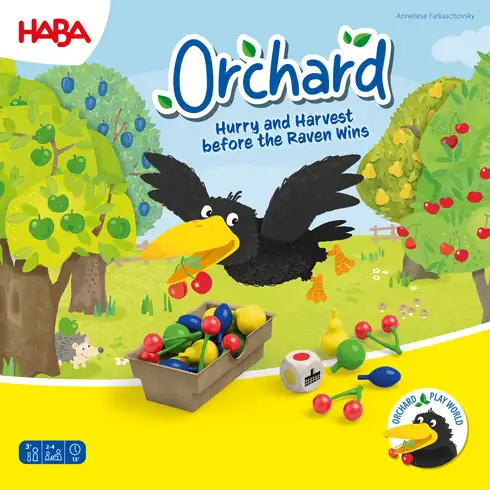
Four fruit trees each bear ten wooden fruits: apples, pears, cherries, plums. Players take turns rolling the color die: on red, yellow, green or blue, a fruit of that color goes into the player’s own basket; if the tree is empty, nothing happens. The basket symbol lets the player take any two fruits, and the raven adds one of nine puzzle pieces to the middle of the table. If all the fruit is harvested before the raven puzzle is finished, everyone wins together; otherwise the raven wins.
What it can help develop
Every roll calls for matching: yellow means pear, blue means plum. Children practice telling colors apart and linking a symbol to an action, a first step on the way to games with rules. Impulse control is needed: players take only what the die shows and then wait. With the basket symbol, children choose for themselves; anyone who always takes their favorite fruit notices that full trees need many rolls. Everyone loses together, which keeps frustration low. Along the way, the large wooden fruits also call for a little manual dexterity.
Especially suitable for
- Three-year-olds, as their very first game with rules
- Children who find losing hard to bear
- Children who are learning their colors
Less suitable for
- Children from about age five who want decisions to make
- Children under three, for whom there is “First Orchard”
Our verdict
Orchard Game is a worthwhile choice for children from age 3 as their very first game with rules, especially those who find losing hard to bear. Everyone harvests together against the raven, the wooden components are high quality and games are short. Its limitations are the high luck factor, downtime in large groups and the lack of decisions for children from about age five.
Getting started
- At the start, match colors and fruits together: red stands for cherry, yellow for pear, blue for plum, green for apple.
- Explain beforehand that nothing happens when a tree is empty.
In detail
Variants and player count
According to the multilingual instructions (Habermaass, item number 4170), 1 to 8 children play; with more than four children, several share a basket. According to the current HABA product page, the components include 10 large wooden fruits per tree and a raven puzzle with 9 pieces. The game idea comes from Anneliese Farkaschovsky; the instructions give 1986 as the copyright year. For children under 3, a HABA press release from October 2024 names “First Orchard”, from age 2.
What reviewers say
According to spielist.de (2021), Orchard Game has often been regarded as one of the first games for children since 1986; the wooden components, the suitable playing time and the frustration-free introduction are praised. The same review calls it a game of pure luck in which no coordination is needed and each child decides for themselves at the basket; according to the review, there is longer downtime with more than four players. According to this review, children outgrow the game by the age of 5 at the latest. A review of the new edition on cliquenabend.de calls the components high-quality and the luck factor high; according to that review, children played enthusiastically from the start, and games took hardly longer than 15 minutes.
How it compares
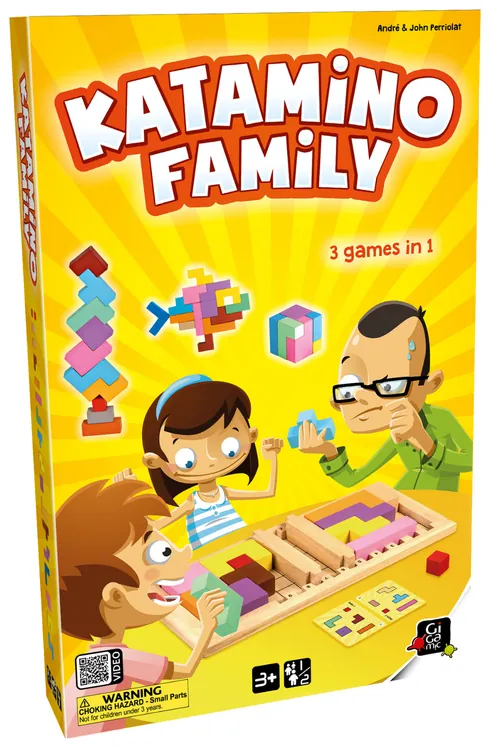
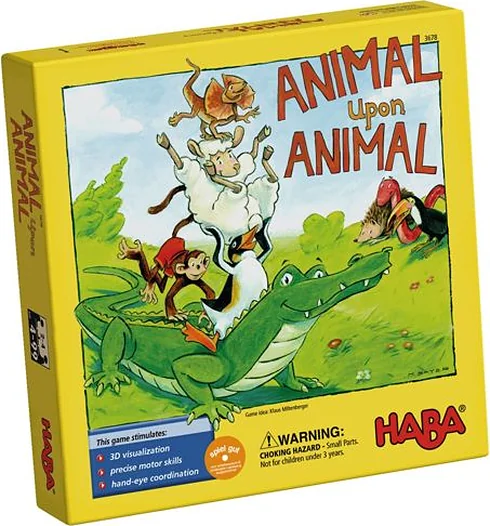
Katamino Family (from age 3, 1 to 2 people, about 15 minutes) shares the age and fine motor skills with Orchard Game; Katamino Family also has logic and planning, and its focus is on spatial reasoning. Katamino Family is less suited to children who give up quickly under time pressure. Animal Upon Animal (from age 4, 2 to 4 people, about 15 minutes) shares fine motor skills with Orchard Game (from age 3, 1 to 8 people, about 10 minutes). Instead of cooperation, Animal Upon Animal has logic and planning. Orchard Game suits three-year-olds as a very first game with rules and children who find losing hard to bear; children from about five who want decisions to make are less well served by Orchard Game.
Sources
Frequently asked questions
What age is Orchard Game suitable for?
Orchard Game is recommended from age 3, and for children under 3 there is “First Orchard” from age 2. Children who are learning their colors are ready; everyone wins or loses together. According to one review, children have outgrown the game by the age of 5 at the latest.
How long does a game take and how many people can play?
A game takes about 10 minutes. The game is for 1 to 8 people, who play together against the raven; as soon as more than four children play, several of them share a basket and there is more downtime.
What skills can Orchard Game help develop?
It can help develop fine motor skills and cooperation. For example, children grasp the large wooden fruits, match the colors on the die to fruits and win or lose together against the raven, which keeps frustration low.
Is Orchard Game purely a matter of luck?
Largely: according to one review, it is a game of pure luck with no need for players to coordinate, and another speaks of a high luck factor. Only with the basket symbol does each child choose which fruits to take.