How it plays
In the edition reviewed, all twelve brightly colored space creatures start in the lid of the transport box, and each has a different shape and an embossed letter from A to L. The player chooses one of the 100 challenges in the booklet of the edition reviewed and first places the pictured creatures in their positions on the playing surface. The remaining pieces must be turned and flipped so that all twelve fit in the end. The challenge is then solved; the challenges span several difficulty levels.
What it can help develop
The focus is on spatial reasoning: which creature fits this gap, and in which position? Anyone who works this out in their head before the hand tries it practices mental rotation. Trickier challenges call for problem-solving with a plan: filling tight spots early, recognizing dead ends, taking pieces out again and starting afresh. This calls for perseverance and a calm way of dealing with failed attempts; fitting pieces in exactly also takes a steady hand.
Especially suitable for
- Children from age 6 who enjoy puzzling things out alone
- On the go: car, train, waiting room
- Children and adults who like shape puzzles
Less suitable for
- Children who would rather play together
- Children who give up quickly at dead ends
Our verdict
Cosmic Creature is suitable for children from age 6 who enjoy puzzling things out on their own, especially in the car, on the train or in a waiting room. Its strength: a compact shape puzzle that calls for spatial reasoning, with challenges across several difficulty levels. Its limitations are the focus on one player and dead ends, which discourage some children.
Getting started
- Start by placing the creatures shown in the booklet of the edition reviewed in their positions, and only then fit in the remaining pieces.
- With tricky challenges, start with the tightest spots.
In detail
Variants and player count
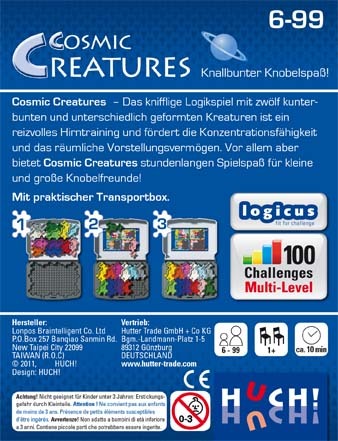
According to the page of the German publisher (Hutter Trade, HUCH!), the edition reviewed includes twelve space creatures, a booklet of challenges and a practical transport box; it is intended for 1 person aged 6 to 99. The back of the box, © 2011 HUCH!, mentions challenges at several levels (multi-level) and names Lonpos Brainteligent (Taiwan) as the manufacturer. According to the instructions of the edition reviewed, all 12 pieces start in the lid of the transport box. The player chooses a challenge from the booklet, places the pictured pieces on the playing surface and fits in the others so that all of them find room. The pieces are embossed with letters from A to L; on pieces that are not symmetrical, a circle and a triangle mark the front and the back.
What reviewers say
No independent expert review of the HUCH! edition is listed. A customer review on spiele-offensive.de from November 2011 calls the game a pastime for the car that went down well with all age groups. On the Lonpos puzzle Cosmic Creature, the blog mypuzzlecollection writes that it is easy at first, then quickly gets hard and takes a lot of patience and trial and error. The blog Welt der Geduldspiele describes the Lonpos puzzle Cosmic Creature with 12 pieces shaped like aliens; half of the pieces change their shape when they are turned over.
How it compares
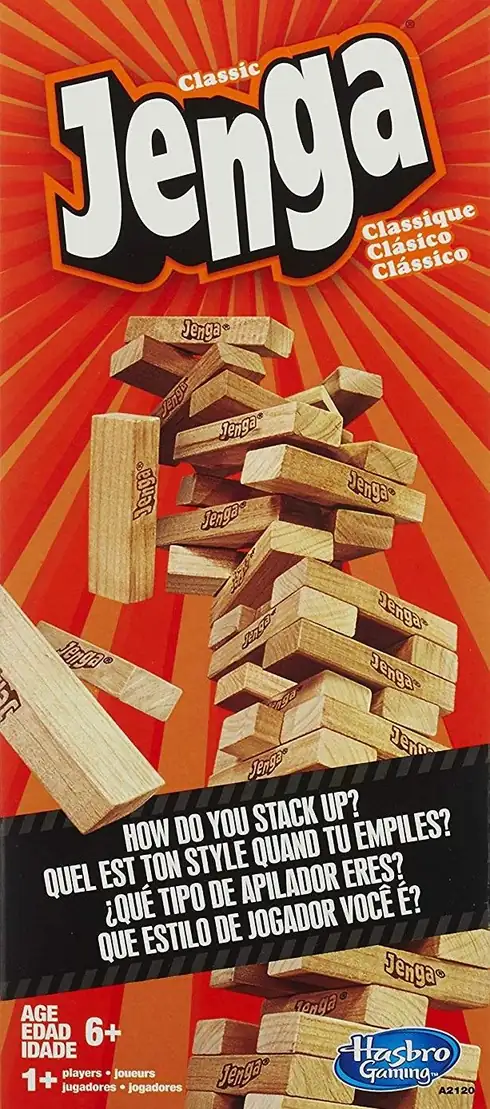
Cosmic Creature (from age 6, 1 person, about 10 minutes) has the skill areas of fine motor skills as well as logic and planning. Jenga (from age 6, 1 or more people, about 15 to 20 minutes) shares the age and the skill area of fine motor skills with Cosmic Creature; logic and planning is listed only for Cosmic Creature. The catalog lists Cosmic Creature for children who like puzzling things out alone and less for children who give up quickly at dead ends. Dr. Eureka (from age 6, 2 to 4 people, about 15 minutes) also has these skill areas, but it is meant for several people. It calls for fine motor skills and controlled force, planning ahead and impulse control. According to the catalog, Dr. Eureka is less suited to children who cope badly with hectic play and being eliminated.
Sources
- Hutter Trade: Cosmic Creatures (publisher’s page, in German)
- Hutter Trade: Cosmic Creatures instructions (PDF, in German)
- Hutter Trade: Cosmic Creatures (back of the box, image)
- Spiele-Offensive: Cosmic Creatures (retailer page with customer review, in German)
- mypuzzlecollection: Lonpos Cosmic Creature (blog)
- Welt der Geduldspiele: Lonpos Cosmic Creature (blog, in German)
Frequently asked questions
What age is Cosmic Creature suitable for?
Cosmic Creature is recommended from age 6. A child is ready when they enjoy turning and flipping pieces and can bear to take them out again and start over. Anyone who gives up quickly at dead ends will enjoy it less.
How long does a game take and how many people can play?
The playing time is given as about 10 minutes. It is played alone: the game is meant for 1 person, and anyone who prefers to play with others is less well served here.
What skills can Cosmic Creature help develop?
It can help develop fine motor skills as well as logic and planning. Anyone who first turns a creature in their head and then places it practices spatial visualization. With tricky challenges, it pays to fill the difficult gaps first and to start over calmly after failed attempts. Fitting pieces in exactly takes a steady hand.
Is Cosmic Creature good for playing on the go?
Yes. In the edition reviewed, the twelve creatures are kept in a transport box. A customer review from 2011 describes the edition reviewed as a pastime in the car that went down well in all age groups. The challenges are spread across several difficulty levels.