How it plays
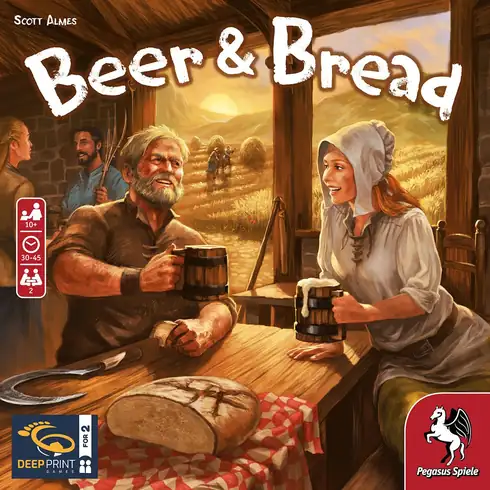
Two villages share fields and a river and compete for six years to make the best beer and bread. Each card has three uses, but only one counts per turn. It can be placed in the harvest row to collect wooden resource tokens, used to make and sell the beer or bread shown on it, or slid under the board as an upgrade. In fruitful years, after one turn each, both players swap their remaining cards in hand. For each player, only the weaker type of goods is scored; whoever has more coins from it wins.
What it can help develop
Beer & Bread calls above all for planning ahead: every card forces a choice between harvesting, selling and an upgrade with a lasting advantage. And because only the weaker type of goods counts, beer and bread have to stay in balance. Working memory keeps track of stock, recipes and the cards that are passed on and come back when hands are swapped. If the other village snaps up the last tokens of a resource, cognitive flexibility is needed: changing plans instead of stubbornly sticking to the old one.
Especially suitable for
- Children from age 10 who enjoy puzzling things out and planning
- A parent and an older child playing head-to-head
- Couples looking for a compact head-to-head game
Less suitable for
- Families with three or more players
- Children who do not yet think several turns ahead
Our verdict
Beer & Bread is a worthwhile choice for a compact duel between a parent and a child from age 10 who both enjoy planning ahead. The cards offer plenty of choice, fruitful and dry years add variety, the final scoring rewards balance and the game was nominated at the 2022 Golden Geek Awards. Its limitations are that it is strictly a two-player game, that reviews criticize the luck of the draw and that swapped cards have to be kept in mind.
Getting started
- First show the three uses of each card: harvesting and storing, producing and selling, or upgrading; players choose one per turn.
- Explain the scoring early on: for each player, only the type of goods with fewer coins counts.
- When the tokens of a resource are gone, change plans rather than stubbornly sticking to the old one.
In detail
Variants and player count
According to the German publisher, Deep Print Games, Beer & Bread is a Kennerspiel, that is, a game for experienced players, for 2 people from age 10 with a playing time of 30 to 45 minutes. According to the rules of the German edition, 84 wooden resource tokens are included.
What reviewers say
According to Board Game Wire, Beer & Bread was nominated at the 2022 Golden Geek Awards (17th Annual) in the “2-Player Game” category. Board Game Quest praises the multi-purpose cards, the alternation of the years, the final scoring and how easy the game is to explain. In the review by Board Game Quest, the luck of the draw and the effort of remembering the cards swapped in fruitful years are criticized. Meeple Mountain praises the scoring system, in which the lower of the two totals counts, the difficult card decisions and the easy rules explanation. As its only point of criticism, Meeple Mountain names the hops, which are rarely needed. The Tabletop Times describes many options per card, the alternation of fruitful and dry years and indirect interaction. According to The Tabletop Times, players have to change their plans when the opponent plays a card they need or takes the last resource of a kind.
How it compares
Kamisado (from age 10, 2 people, about 30 minutes) shares the age, the two-player format and the skill area of logic and planning with Beer & Bread and, like Beer & Bread, calls for planning and working memory. Kamisado is less suited to players looking for luck, a theme or conversation at the table. Carpe Diem (from age 10, 2 to 4 people, about 45 to 75 minutes) also has logic and planning as its skill area. Carpe Diem likewise calls for planning and working memory, plus spatial reasoning when placing tiles in the grid, and it takes longer. Carpe Diem is less suited to children who need a lively theme. Beer & Bread suits children from age 10 who enjoy puzzling and planning, a parent and an older child playing head to head, and couples looking for a compact duel. Beer & Bread is less suited to families of three or more players and to children who cannot yet think several moves ahead.
Sources
Frequently asked questions
What age is Beer & Bread suitable for?
Beer & Bread is recommended from age 10. A child is ready when they think several turns ahead and enjoy weighing up three possible uses for every card. Anyone who still thinks only one turn at a time struggles.
How long does a game take and how many people can play?
A game takes about 30 to 45 minutes and covers six years, alternating between fruitful and dry. The game is for exactly 2 people, who play against each other; it is less suitable for groups of three or more.
What skills can Beer & Bread help develop?
The skills profile lists logic and planning. With every card, children choose between harvesting, selling and upgrading. Since the weaker of the two types of goods decides at the end, the aim is to keep the production of beer and bread balanced. Once the tokens of a resource have been taken, it is time to change plans.
Is Beer & Bread easy to explain?
Reviews describe the rules as easy to explain. The decisions are more demanding, because players choose one of three uses each turn and swapped cards have to be kept in mind.